Activity 8.2.3.
Let \(f(x) = \ln(x)\text{,}\) and recall that \(f\) is only defined for \(x \gt 0\text{.}\) As such, we can’t consider the tangent line (or any other) approximation at \(a = 0\text{.}\) Instead, we choose to work with an approximation to \(f(x) = \ln(x)\) centered at \(a = 1\) and will find the degree \(4\) Taylor polynomial approximation
\begin{equation*}
T_4(x) = c_0 + c_1 (x-1) + c_2 (x-1)^2 + c_3(x-1)^3 + c_4(x-1)^4\text{.}
\end{equation*}
(a)
Determine \(f'(x)\text{,}\) \(f''(x)\text{,}\) \(f'''(x)\text{,}\) and \(f^{(4)}(x)\text{,}\) and then compute \(f'(1)\text{,}\) \(f''(1)\text{,}\) \(f'''(1)\text{,}\) and \(f^{(4)}(1)\text{.}\) Enter your results in the provided blanks below.
\begin{align*}
k \amp= 0 \amp f(x) \amp= \ln(x) \amp f(1) \amp= \ln(1) = 0\\
k \amp= \fillinmath{XX} \amp f'(x) \amp= \fillinmath{XXXXX} \amp f'(1) \amp= \fillinmath{XXXXX}\\
k \amp= \fillinmath{XX} \amp f''(x) \amp= \fillinmath{XXXXX} \amp f''(1) \amp= \fillinmath{XXXXX}\\
k \amp= \fillinmath{XX} \amp f'''(x) \amp= \fillinmath{XXXXX} \amp f'''(1) \amp= \fillinmath{XXXXX}\\
k \amp= \fillinmath{XX} \amp f^{(4)}(x) \amp= \fillinmath{XXXXX} \amp f^{(4)}(1) \amp= \fillinmath{XXXXX}
\end{align*}
(b)
Use your work in (a) along with the fact that the coefficients of the Taylor polynomial are determined by \(c_k = \frac{f^{(k)}(a)}{k!}\) to determine
\begin{equation*}
T_4(x) = c_0 + c_1 (x-1) + c_2 (x-1)^2 + c_3(x-1)^3 + c_4(x-1)^4\text{.}
\end{equation*}
(c)
Use appropriate technology to plot \(f(x) = \ln(x)\text{,}\) its tangent line, \(T_1(x) = x - 1\text{,}\) and \(T_4(x)\) in the same window shown in Figure 8.2.17.
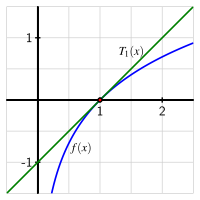
The function \(f(x)=\ln(x)\) graphed together with its degree \(1\) Taylor polynomial approximation near the point \((1,f(1))\text{.}\)
The graph shows that the function and its Taylor approximation intersect at the point \((1,f(1))\) and have the same slope at that point.
The two functions are very close together on the interval \((0.5,1.5)\text{,}\) but outside of that interval there start to be visual differences as the tangent line continues straight, but the function \(\ln(x)\) is curved.
What do you notice?
(d)
Compute \(|f(x) - T_4(x)|\) for several different \(x\) values (you might find it helpful to use a slider in Desmos in the variable \(b\) to experiment with \(|f(b) - T_4(b)|\)); for approximately what values of \(x\) is it true that \(|f(x) - T_4(x)| \lt 0.1\text{?}\)
(e)
Use the patterns you observe in your work in parts (a) and (b) to conjecture formulas for \(T_5(x)\) and \(T_6(x)\text{.}\)
For approximately what interval of \(x\)-values is it true that \(|f(x) - T_5(x)| \lt 0.1\text{?}\) What about \(|f(x) - T_6(x)| \lt 0.1\text{?}\) How is this situation different from what we observed with \(f(x) = \cos(x)\) in Activity 8.2.2?

