Skip to main content
Contents Index
Search Book
Search Results:
No results.
Read aloud Readability settings Prev Up Next Scratch ActiveCode Profile title here \(\newcommand{\dollar}{\$}
\DeclareMathOperator{\erf}{erf}
\DeclareMathOperator{\arctanh}{arctanh}
\DeclareMathOperator{\arcsec}{arcsec}
\newcommand{\lt}{<}
\newcommand{\gt}{>}
\newcommand{\amp}{&}
\definecolor{fillinmathshade}{gray}{0.9}
\newcommand{\fillinmath}[1]{\mathchoice{\colorbox{fillinmathshade}{$\displaystyle \phantom{\,#1\,}$}}{\colorbox{fillinmathshade}{$\textstyle \phantom{\,#1\,}$}}{\colorbox{fillinmathshade}{$\scriptstyle \phantom{\,#1\,}$}}{\colorbox{fillinmathshade}{$\scriptscriptstyle\phantom{\,#1\,}$}}}
\)
Appendix C Answers to Selected Exercises
This appendix contains answers to all non-WeBWorK exercises in the text.
1 Understanding the Derivative 1.1 How do we measure velocity? 1.1.5 Exercises
Answer .
\(s(15)-s(0) \approx -98.75\text{.}\)
\begin{align*}
AV_{[0,15]} &= \frac{s(15)-s(0)}{15-0} \approx -6.58\\
AV_{[0,2]} &= \frac{s(2)-s(0)}{2-0} \approx -47.63\\
AV_{[1,6]} &= \frac{s(6)-s(1)}{6-1} \approx -13.25\\
AV_{[8,10]} &= \frac{s(10)-s(8)}{10-8} \approx -7.35
\end{align*}
Most negative average velocity on
\([0,4]\text{;}\) most positive average velocity on
\([4,8]\text{.}\)
\(\frac{21.31+22.25}{2} = 21.78\) feet per second.
The average velocities are negative; the instantaneous velocity was positive. Downward motion corresponds to negative average velocity; upward motion to positive average velocity.
Answer .
Sketch a plot where the diver’s height at time
\(t\) is on the vertical axis. For instance,
\(h(2.45) = 0\text{.}\)
\(AV_{[2.45,7]} \approx \frac{-3.5-0}{7-2.45}=\frac{-3.5}{4.55}=-0.7692\) m/sec. The average velocity is not the same on every time interval within
\([2.45,7]\text{.}\)
When the diver is going upward, her velocity is positive. When she is going downward, her velocity is negative. At the peak of her dive and when her feet touch the bottom of the pool.
It looks like when the position function is steep, the velocity function’s value is farther away from zero, and that whenever the height/position function is rising/increasing, the velocity function has a positive value. Similarly, whenever the position function is decreasing, the velocity is negative.
Answer .
In an average year the population grew by about
\(798\) people/year.
The slope of a secant line through the points
\((a,f(a))\) and
\((b,f(b))\text{.}\)
\(AV_{[0,20]} \approx 798\) people per year.
\begin{align*}
AV_{[5,10]} & \approx 734.50\\
AV_{[5,9]} & \approx 733.06\\
AV_{[5,8]} & \approx 731.62\\
AV_{[5,7]} & \approx 730.19\\
AV_{[5,6]} & \approx 728.7535
\end{align*}
1.2 The notion of limit 1.2.5 Exercises
Answer .
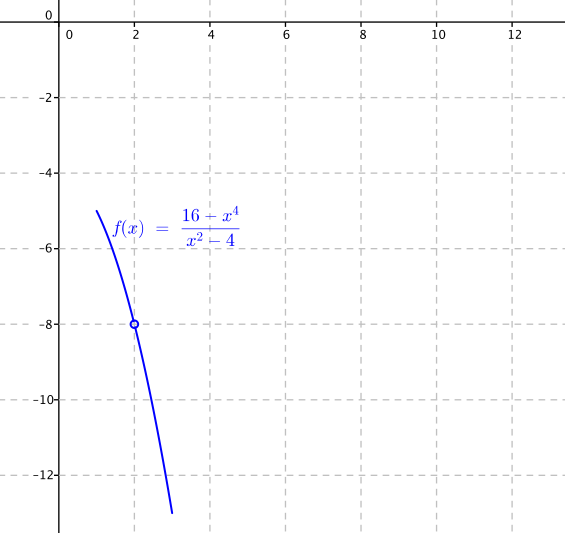
All real numbers except
\(x = \pm 2\text{.}\)
\(x\) \(f(x)\)
\(2.1\) \(-8.41\)
\(2.01\) \(-8.0401\)
\(2.001\) \(-8.004001\)
\(1.999\) \(-7.996001\)
\(1.99\) \(-7.9601\)
\(1.9\) \(-7.61\)
\(\lim_{x \to 2} f(x) = -8\text{.}\)
\(\lim_{x \to 2} \frac{16-x^4}{x^2-4} = -8\text{.}\)
Answer .
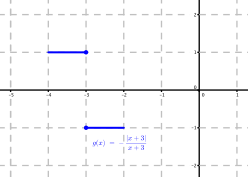
All real numbers except
\(x = -3\text{.}\)
\(x\) \(g(x)\)
\(-2.9\) \(-1\)
\(-2.99\) \(-1\)
\(-2.999\) \(-1\)
\(-3.001\) \(1\)
\(-3.01\) \(-1\)
\(-3.1\) \(-1\)
The limit does not exist.
If \(x \gt -3\text{,}\)
\begin{equation*}
-\frac{|x+3|}{x+3} = -\frac{x+3}{x+3} = -1;
\end{equation*}
if \(x \lt -3\text{,}\) it follows that
\begin{equation*}
-\frac{|x+3|}{x+3} = -\frac{-(x+3)}{x+3} = +1\text{.}
\end{equation*}
Hence the limit does not exist.
Answer .
\begin{equation*}
AV_{[1,1+h]} = \frac{100\cos(0.75(1+h)) \cdot e^{-0.2(1+h)} - 100\cos(0.75) \cdot e^{-0.2}}{h}
\end{equation*}
\begin{equation*}
\lim_{h \to 0} AV_{1, 1+h} \approx -53.837\text{.}
\end{equation*}
The instantaneous velocity of the bungee jumper at the moment
\(t = 1\) is approximately
\(-53.837\) ft/sec.
1.3 The derivative of a function at a point 1.3.4 Exercises
Answer .
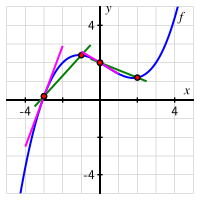
\(AV_{[-3,-1]} \approx 1.15\text{;}\) \(AV_{[0,2]} \approx -0.4\text{.}\)
\(f'(-3) \approx 3\text{;}\) \(f'(0) \approx -\frac{1}{2}\text{.}\)
Answer .
For instance, you could let
\(f(-3) = 3\) and have
\(f\) pass through the points
\((-3,3)\text{,}\) \((-1,-2)\text{,}\) \((0,-3)\text{,}\) \((1,-2)\text{,}\) and
\((3,-1)\) and draw the desired tangent lines accordingly.
For instance, you could draw a function
\(g\) that passes through the points
\((-2,3)\text{,}\) \((-1,2)\text{,}\) \((1,0)\text{,}\) \((2,0)\text{,}\) and
\((3,3)\) in such a way that the tangent line at
\((-1,2)\) is horizontal and the tangent line at
\((2,0)\) has slope
\(1\text{.}\)
Answer .
\(AV_{[0,7]}=\frac{0.1175}{7} \approx 0.01679\) billion people per year;
\(P'(7) \approx 0.1762\) billion people per year;
\(P'(7) \gt AV_{[0,7]}\text{.}\)
\(AV_{[19,29]} \approx 0.02234\) billion people/year.
We will say that today’s date is July 1, 2015, which means that \(t = 22.5\text{;}\)
\begin{equation*}
P'(22.5) = \lim_{h \to 0} \frac{115(1.014)^{22.5+h}-115(1.014)^{22.5}}{h};
\end{equation*}
\(P'(22.5) \approx 0.02186\) billions of people per year.
\(y - 1.57236 = 0.02186(t-22.5)\text{.}\)
Answer .
All three approaches show that
\(f'(2) = 1\text{.}\)
All three approaches show that
\(f'(1) = -1\text{.}\)
All three approaches show that
\(f'(1) = \frac{1}{2}\text{.}\)
All three approaches show that
\(f'(1)\) does not exist.
The first two approaches show that
\(f'(\frac{\pi}{2}) = 0\text{.}\)
1.4 The derivative function 1.4.4 Exercises
Answer .
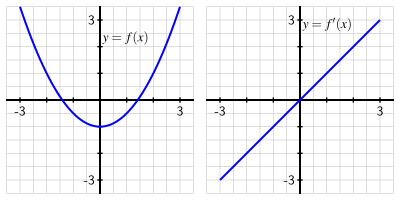
One example of a formula for
\(f\) is
\(f(x) = \frac{1}{2}x^2 - 1\text{.}\)
Answer .
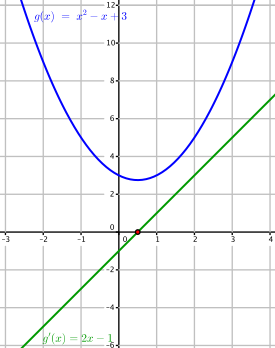
\(g'(x) = 2x - 1\text{.}\)
\(p'(x) = 10x - 4\text{.}\)
The constants
\(3\) and
\(12\) don’t seem to affect the results at all. The coefficient
\(-4\) on the linear term in
\(p(x)\) appears to make the “
\(-4\) ” appear in
\(p'(x)= 10x - 4\text{.}\) The leading coefficient
\(5\) in
\((x) = 5x^2 - 4x + 12\) leads to the coefficient of “
\(10\) ” in
\(p'(x) = 10x -4\text{.}\)
Answer .
On
\(-3.5 \lt x \lt -2\text{,}\) \(-2 \lt x \lt 0\) and
\(2 \lt x \lt 3.5\text{.}\)
At
\(x = -2, 0, 2\text{;}\) \(g\) must have sharp corners at these points.
1.5 Interpreting, estimating, and using the derivative 1.5.5 Exercises
Answer .
\(F'(10) \approx -3.33592\text{.}\)
The coffee’s temperature is decreasing at about
\(3.33592\) degrees per minute.
We expect
\(F'\) to get closer and closer to
\(0\) as time goes on.
Answer .
If a patient takes a dose of
\(50\) ml of a drug, the patient will experience a body temperature change of
\(0.75\) degrees F.
“degrees Fahrenheit per milliliter.”
For a patient taking a
\(50\) ml dose, adding one more ml to the dose leads us to expect a temperature change that is about
\(0.02\) degrees less than the temperature change induced by a
\(50\) ml dose.
Answer .
“feet per second per second”;
\(v'(1) = -32\) tells us that the ball’s velocity is decreasing at a rate of 32 feet per second per second.
The acceleration of the ball.
Answer .
\(AV_{[40000,55000]} \approx -0.153 \) dollars per mile.
\(h'(55000) \approx -0.147\) dollars per mile. During
\(55 0001\) st mile, we expect the car’s value to drop by
\(0.147\) dollars.
\(h'(30000) \lt h'(80000)\text{.}\)
The graph of
\(h\) might have the general shape of the graph of
\(y = e^{-x}\) for positive values of
\(x\text{:}\) always positive, always decreasing, and bending upwards while tending to
\(0\) as
\(x\) increases.
1.6 The second derivative 1.6.6 Exercises
Answer .
\(f\) is increasing and concave down near
\(x=2\text{.}\)
Answer .
\(g'(2) \approx 1.4\text{.}\)
\(g''(2) \approx 5.5
\text{.}\)
Answer .
\(h'(4.5) \approx 14.3\text{;}\) \(h'(5) \approx 21.2\text{;}\) \(h'(5.5) \approx = 23.9\text{;}\) rising most rapidly at
\(t = 5.5\text{.}\)
\(h'(5) \approx 9.6
\text{.}\)
Acceleration of the bungee jumper in feet per second per second.
\(0 \lt t \lt 2\text{,}\) \(6 \lt t \lt 10\text{.}\)
1.7 Limits, continuity, and differentiability 1.7.6 Exercises
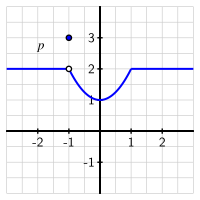
Answer .
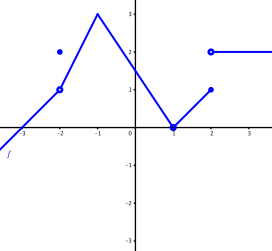
\(a = -2, 0, 1, 2, 3\text{.}\)
Answer .
Let
\(f\) be the function defined to be
\(f(x) = 1\) for every value of
\(x \ne -2\text{,}\) and such that
\(f(-2) = 4\text{.}\)
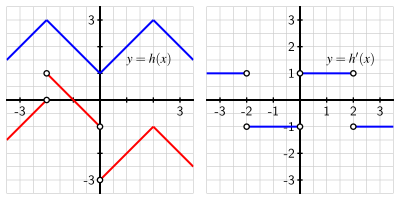
Answer .
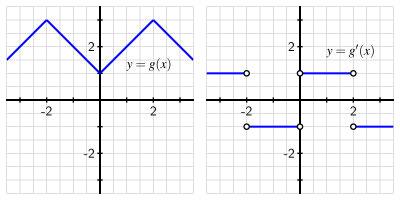
\(h\) must be piecewise linear with slope of
\(1\) or
\(-1\text{,}\) depending on the interval.
\(h'(x)\) is not defined for
\(x = -2, 0, 2\text{.}\)
It is possible that
\(h\) is not continuous at
\(x = -2, 0, 2\text{.}\)
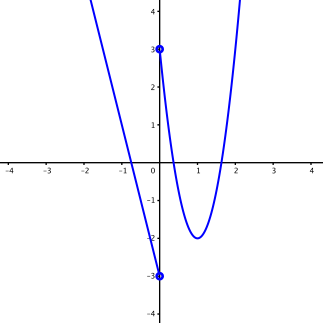
Two of the many possible graphs for
\(h\) are shown in the following figure.
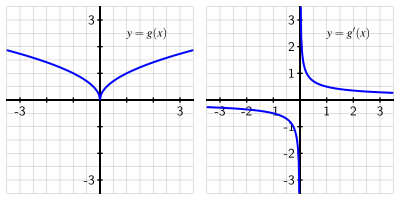
Answer .
\begin{align*}
g'(0) & = \lim_{h \to 0} \frac{g(0+h) - g(0)}{h}\\
& = \lim_{h \to 0} \frac{\sqrt{|h|} - \sqrt{|0|}}{h}\\
& = \lim_{h \to 0} \frac{\sqrt{|h|}}{h}
\end{align*}
\(h\) \(0.1\) \(0.01\) \(0.001\) \(0.0001\) \(-0.1\) \(-0.01\) \(-0.001\) \(-0.0001\)
\(\sqrt{|h|}/h\) \(3.162\) \(10\) \(31.62\) \(100\) \(-3.162\) \(-10\) \(-31.62\) \(-100\)
\(g'(0)\) does not exist.
1.8 The tangent line approximation 1.8.5 Exercises
Answer .
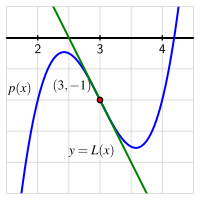
\(p(3) = -1\) and
\(p'(3) = -2\text{.}\)
\(p(2.79) \approx -0.58\text{.}\)
Answer .
\(F'(30)\approx 2.065\) degrees per minute.
\(L(t) \approx 2.065(t-30) + 167.6\text{.}\)
\(F(33) \approx L(63) = 173.795\) degrees F.
Answer .
\(s(9.34) \approx L(9.34) = 3.592\text{.}\)
The object is slowing down as it moves toward toward its starting position at
\(t=4\text{.}\)
Answer .
On
\(-0.37 \lt x \lt 1.37\text{;}\) \(f\) is concave up.
\(f(1.88) \approx -3.0022\text{,}\) and this estimate is larger than the true value of
\(f(1.88)\text{.}\)
2 Computing Derivatives 2.1 Elementary derivative rules 2.1.6 Exercises
Answer .
\(h(2) = 27\text{;}\) \(h'(2) = -19/2\text{.}\)
\(L(x) = 27 - \frac{19}{2}(x-2)\text{.}\)
\(p\) is increasing at
\(x=2\text{.}\)
\(p(2.03) \approx -11.44\text{.}\)
Answer .
\(p\) is not differentiable at
\(x=-1\) and
\(x=1\text{;}\) \(q\) is not differentiable at
\(x=-1\) and
\(x=1\text{.}\)
\(r\) is not differentiable at
\(x=-1\) and
\(x=1\text{.}\)
\(r'(-2) = 4\text{;}\) \(r'(0) = \frac{1}{2}\text{.}\)
Answer .
\(w'(t) = 3t^t(\ln(t) + 1) + 2\frac{1}{\sqrt{1-t^2}}\text{.}\)
\(L(t) = (\frac{3}{\sqrt{2}} - \frac{2\pi}{3}) + (\frac{3}{\sqrt{2}}(\ln(\frac{1}{2}) + 1) + \frac{4}{\sqrt{3}})(t-\frac{1}{2})\text{.}\)
\(v\) is decreasing at
\(t = \frac{1}{2}\text{.}\)
Answer .
\begin{align*}
f'(x) &= \lim_{h \to 0} \frac{a^{x+h}-a^x}{h}\\
&= \lim_{h \to 0} \frac{a^{x} \cdot a^{h} - a^x}{h}\\
&= \lim_{h \to 0} \frac{a^{x}(a^{h}-1)}{h}\text{,}
\end{align*}
Since
\(a^x\) does not depend at all on
\(h\text{,}\) we may treat
\(a^x\) as constant in the noted limit and thus write the value
\(a^x\) in front of the limit being taken.
When
\(a = 2\text{,}\) \(L \approx 0.6931\text{;}\) when
\(a = 3\text{,}\) \(L \approx 1.0986\text{.}\)
\(a \approx 2.71828\) (for which
\(L \approx 1.000\) )
\(\frac{d}{dx}[2^x] = 2^x \cdot \ln(2)\) and
\(\frac{d}{dx}[3^x] = 3^x \cdot \ln(3)\)
\begin{equation*}
\frac{d}{dx}[e^x] = e^x\text{.}
\end{equation*}
2.2 The sine and cosine functions 2.2.4 Exercises
Answer .
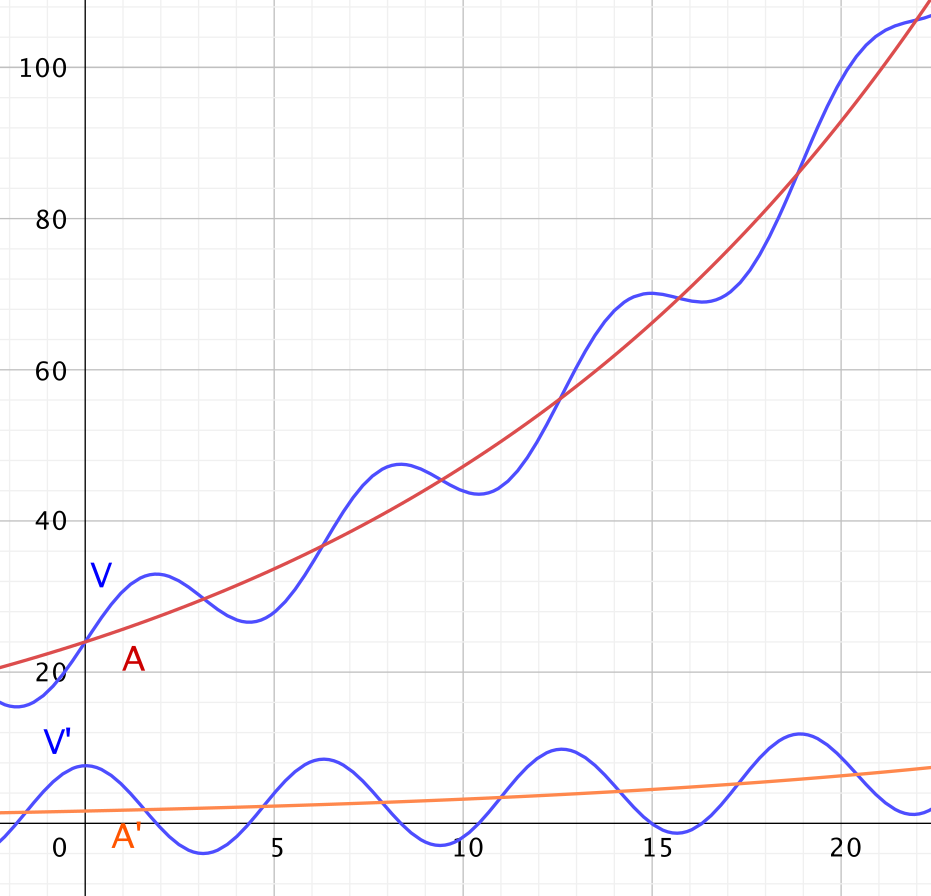
\(V'(2) = 24 \cdot 1.07^2 \cdot \ln(1.07) + 6 \cos(2) \approx -0.63778\) thousands of dollars per year.
\(V''(2) = 24 \cdot 1.07^2 \cdot \ln(1.07)^2 - 6 \sin(2) \approx -5.33\) thousands of dollars per year per year. At this moment,
\(V'\) is decreasing and we expect the derivative’s value to decrease by about
\(5.33\) thousand dollars per year over the course of the next year.
See the figure below. Adding the term
\(6\sin(t)\) to
\(A\) to create the function
\(V\) adds volatility to the value of the portfolio.
Answer .
\(f'\left(\frac{\pi}{4}\right) = -5\left(\frac{\sqrt{2}}{2}\right)\text{.}\)
\(L(x) = 3+2(x-\pi)\text{.}\)
The tangent line to
\(f\) lies above the curve at this point.
Answer .
Hint: in the numerator of the difference quotient, combine the first and last terms and remove a factor of
\(\sin(x)\text{.}\)
Hint: divide each part of the numerator by
\(h\) and consider the sum of two separate limits.
\(\lim_{h \to 0} \left( \frac{\cos(h)-1}{h} \right) = 0\) and
\(\lim_{h \to 0} \left( \frac{\sin(h)}{h} \right) = 1
\text{.}\)
\(f'(x) = \sin(x) \cdot 0 + \cos(x) \cdot 1\text{.}\)
Hint:
\(\cos(\alpha + \beta)\) is
\(\cos(\alpha + \beta) = \cos(\alpha) \cos(\beta) - \sin(\alpha) \sin(\beta)\text{.}\)
2.3 The product and quotient rules 2.3.6 Exercises
Answer .
\(h(2) = -15\text{;}\) \(h'(2) = 23/2\text{.}\)
\(L(x) = -15 + 23/2(x-2)\text{.}\)
\(r(2.06) \approx -0.5796\text{.}\)
Answer .
\(r'(-2) = 5\) and
\(r'(0) = 1\text{.}\)
At
\(x = -1\) and
\(x = 1\text{.}\)
\(z'(0) = -\frac{1}{4}\) and
\(z'(2) = -1\text{.}\)
At
\(x = -1\text{,}\) \(x = 1\text{,}\) \(x = -1.5\text{,}\) and
\(x = 1\text{.}\)
Answer .
\(w'(t) = t^t\left(\ln t+1\right)\cdot\left(\arccos t\right)+t^t\cdot\frac{-1}{\sqrt{1-t^2}}
\text{.}\)
\(L(t) \approx 0.740-0.589(t-0.5)\text{.}\)
Answer .
\(C(t) = A(t)Y(t)\) bushels in year
\(t\text{.}\)
\(1 190 000\) bushels of corn.
\(C'(t) = A(t)Y'(t) + A'(t)Y(t)\text{.}\)
\(C'(0) = 158 000\) bushels per year.
\(C(1) \approx 1 348 000\) bushels.
Answer .
\(g(80) = 20\) kilometers per liter, and
\(g'(80) = -0.16\text{.}\) kilometers per liter per kilometer per hour.
\(h(80) = 4\) liters per hour and
\(h'(80) = 0.082\) liters per hour per kilometer per hour.
Think carefully about units and how each of the three pairs of values expresses fundamentally the same facts.
2.4 Derivatives of other trigonometric functions 2.4.4 Exercises
Answer .
\(h'(2) = \frac{-2\sin(2) - 2\cos(2) \ln(1.2)}{1.2^2} \approx -1.1575\) feet per second.
\(h''(2) = \frac{\cos(2)(-2 + 2ln^2(1.2)) + 4\ln(1.2)\sin(2))}{1.2^2} \approx 1.0193\) feet per second per second.
The object is falling and slowing down.
Answer .
\(f'(x) = \sin(x) \cdot (-\csc^2(x)) + \cot(x) \cdot \cos(x)\text{.}\)
\(f'(x) = \frac{-\sin^2(x)}{\sin(x)} = -\sin(x)\) for
\(x \ne \frac{\pi}{2} + k\pi\) for some integer value of
\(k\text{.}\)
Answer .
\(\displaystyle p'(z) = \frac{\left(z^2\sec(z) +1 \right)\left(z\sec^2(z)+\tan(z)\right) - z\tan(z) \left(z^2\sec(z)\tan(z)+2z\sec(z)\right)}{\left(z^2\sec(z) + 1\right)^2} +3e^z\)
\(y - 4 = 3(x-0)\text{.}\)
2.5 The chain rule 2.5.6 Exercises
Answer .
\(h'\left( \frac{\pi}{4} \right) = \frac{3}{2\sqrt{2}}\text{.}\)
\(r'(0.25) = \cos(0.25^3) \cdot 3(0.25)^2 \approx 0.1875 \gt h'(0.25) = 3\sin^2(0.25) \cdot \cos(0.25) \approx 0.1779\text{;}\) \(r\) is changing more rapidly.
\(h'(x)\) is periodic;
\(r'(x)\) is not.
Answer .
\(p'(x) = e^{u(x)} \cdot u'(x)\text{.}\)
\(q'(x) = u'(e^x) \cdot e^x\text{.}\)
\(r'(x) = -\csc^2(u(x)) \cdot u'(x)\text{.}\)
\(s'(x) = u'(\cot(x)) \cdot (-\csc^2(x))\text{.}\)
\(a'(x) = u'(x^4) \cdot 4x^3\text{.}\)
\(b'(x) = 4(u(x))^3 \cdot u'(x)\text{.}\)
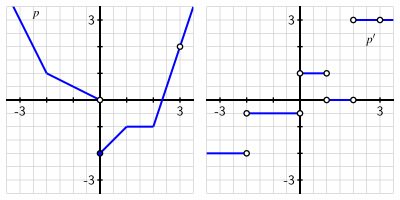
Answer .
\(C'(0) = 0\) and
\(C'(3) = -\frac{1}{2}\text{.}\)
Since
\(Y(x) = q(q(x))\text{,}\) the chain rule implies that
\(Y'(x) = q'(q(x)) \cdot q'(x)\text{,}\) and thus
\(Y'(-2) = q'(q(-2)) \cdot q'(-2) = q'(-1) \cdot q'(-2)\text{.}\) But
\(q'(-1)\) does not exist, so
\(Y'(-2)\) also fails to exist. Using
\(Z(x) = q(p(x))\) and the chain rule, we have
\(Z'(x) = q'(p(x)) \cdot p'(x)\text{.}\) Therefore
\(Z'(0) = q'(p(0)) \cdot p'(0) = q'(-0.5) \cdot p'(0) = 0 \cdot 0.5 = 0\text{.}\)
Answer .
\(\left. \frac{dV}{dh} \right|_{h=1} = 7 \pi\) cubic feet per foot.
\(h'(2) = \pi \cos(2\pi) = \pi\) feet per hour.
\(\left. \frac{dV}{dt} \right|_{t=2} = 7 \pi^2\) cubic feet per hour.
In (a) we are determining the instantaneous rate at which the volume changes as we increase the height of the water in the tank, while in (c) we are finding the instantaneous rate at which volume changes as we increase time.
2.6 Derivatives of inverse functions 2.6.7 Exercises
Answer .
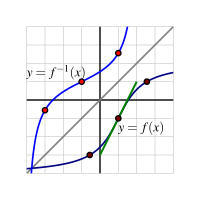
\(f'(1) \approx 2\text{.}\)
\((f^{-1})'(-1) \approx 1/2\text{.}\)
Answer .
\(f'(x) = \frac{1}{2\arctan(x) + 3\arcsin(x) + 5} \cdot \left(\frac{2}{1+x^2} + \frac{3}{\sqrt{1-x^2}}\right)\text{.}\)
\(r'(z) = \frac{1}{1+\left(\ln(\arcsin(z))\right)^2} \cdot \left( \frac{1}{\arcsin(z)} \right) \cdot \frac{1}{\sqrt{1-z^2}}\text{.}\)
\(q'(t) = \arctan^2(3t) \cdot \left[4\arcsin^3(7t) \left( \frac{7}{\sqrt{1-(7t)^2}} \right)\right] + \arcsin^4(7t) \cdot \left[2\arctan(3t) \left(\frac{3}{1+(3t)^2}\right) \right]\text{.}\)
\(\displaystyle g'(v) = \frac{1}{\frac{\arctan(v)}{\arcsin(v) + v^2}} \cdot \frac{(\arcsin(v) + v^2) \cdot \frac{1}{1+v^2} - \arctan(v) \cdot \left(\frac{1}{\sqrt{1-v^2}} + 2v \right)}{(\arcsin(v) + v^2)^2} \)
Answer .
\(f\) passes the horizontal line test.
\(f^{-1}(x) = g(x) = \sqrt[3]{4x-16}\text{.}\)
\(f'(x) = \frac{3}{4}x^2\text{;}\) \(f'(2) = 3\text{.}\) \(g'(x) = \frac{1}{3}(4x-16)^{-2/3} \cdot 4\text{;}\) \(g'(6) = \frac{1}{3}\text{.}\) These two derivative values are reciprocals.
Answer .
\(h\) passes the horizontal line test.
The equation
\(y = x + \sin(x)\) can’t be solved for
\(x\) in terms of
\(y\text{.}\)
\((h^{-1})'(\frac{\pi}{2} + 1) = 1\text{.}\)
2.7 Derivatives of functions given implicitly 2.7.4 Exercises
Answer .
Horizontal tangent lines:
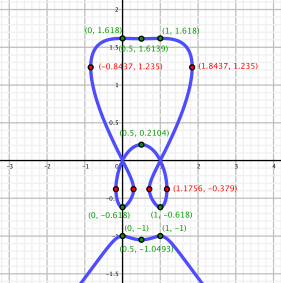
\((0,-1)\text{,}\) \((0,-0.618)\text{,}\) \((0,1.618)\text{,}\) \((1,-1)\text{,}\) \((1,-0.618)\text{,}\) \((1,1.618)\text{,}\) \((0.5,-1.0493)\text{,}\) \((0.5,0.2104)\text{,}\) \((0.5, 1.6139)\text{.}\) Vertical tangent lines:
\((-0.1756,-0.379)\text{,}\) \((0.2912,-0.379)\text{,}\) \((0.7088,-0.379)\text{,}\) \((1.1756,-0.379)\text{,}\) \((-0.8437, 1.235)\text{,}\) and
\((1.8437, 1.235)\text{.}\)
Answer .
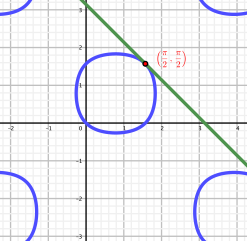
\(y = \frac{\pi}{2} - \left(x-\frac{\pi}{2}\right)\text{.}\)
Answer .
\(x = \frac{\ln(y)}{\ln(a)}\text{.}\)
\(1 = \frac{1}{\ln(a)} \cdot \frac{1}{y}\frac{dy}{dx}\text{.}\)
\(\frac{d}{dx}[a^x] = a^x \ln(a)\text{.}\)
3 Using Derivatives 3.1 Related rates 3.1.4 Exercises
Answer .
The boat is approaching the dock at a rate of
\(\frac{13}{6} \approx 2.167\) feet per second.
Answer .
The depth of the water is increasing at
\begin{equation*}
\left. \frac{dh}{dt}\right|_{h = 5} = 1.28
\end{equation*}
feet per minute. The depth of the water is increasing at a decreasing rate.
Answer .
\(\left. \frac{d\theta}{dt} \right|_{x = 30} = -0.24\) radians per second.
Answer .
\(\left. \frac{dh}{dt}\right|_{V=1000} = \frac{10}{\pi \left( \sqrt[3]{\frac{3000}{\pi}} \right)^2} \approx 0.0328\) feet per minute.
3.2 Using derivatives to evaluate limits 3.2.5 Exercises
Answer .
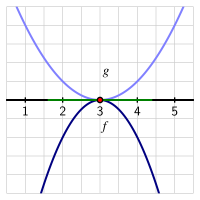
\(\lim_{x \to 3} h(x) = -2\text{.}\)
Answer .
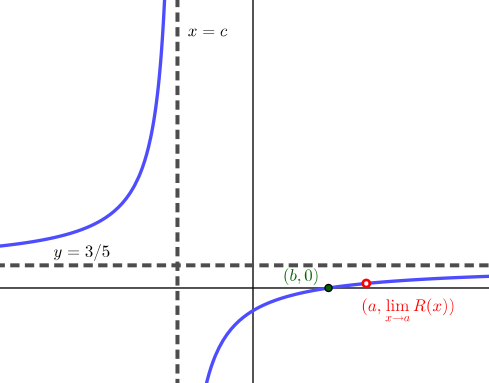
Horizontal asymptote:
\(y = \frac{3}{5}\text{;}\) vertical asymptote:
\(x = c\text{;}\) hole:
\((a, \frac{3(a-b)}{5(a-c)})\text{.}\) \(R\) is not continuous at
\(x = a\) and
\(x = c\text{.}\)
Answer .
\(\ln(x^{2x}) = 2x \cdot \ln(x)\text{.}\)
\(x = \frac{1}{\frac{1}{x}}\text{.}\)
\(\lim_{x \to 0^+} h(x) = 0\text{.}\)
\(\lim_{x \to 0^+} g(x) = \lim_{x \to 0^+} x^{2x} = 1\text{.}\)
Answer .
Show that
\(\lim_{x \to \infty}\frac{\ln(x)}{\sqrt{x}} = 0\text{.}\)
Show that
\(\lim_{x \to \infty}\frac{\ln(x)}{\sqrt[n]{x}} = 0\text{.}\)
Consider
\(\lim_{x \to \infty} \frac{p(x)}{e^x} \) By repeated application of LHR, the numerator will eventually be simply a constant (after
\(n\) applications of LHR), and thus with
\(e^x\) still in the denominator, the overall limit will be
\(0\text{.}\)
Show that
\(\lim_{x \to \infty} \frac{\ln(x)}{x^n} = 0\)
For example,
\(f(x) = 3x^2 + 1\) and
\(g(x) = -0.5x^2 + 5x - 2\text{.}\)
3.3 Using derivatives to identify extreme values 3.3.5 Exercises
Answer .
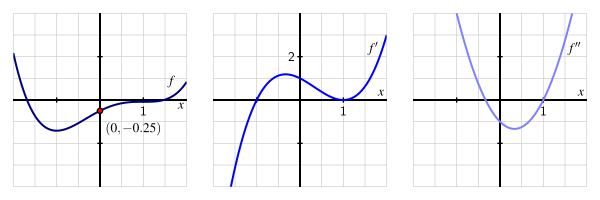
\(f'\) is positive for
\(-1 \lt x lt 1\) and for
\(x \gt 1\text{;}\) \(f'\) is negative for all
\(x \lt -1\text{.}\) \(f\) has a local minimum at
\(x = -1\text{.}\)
A possible graph of
\(y = f''(x)\) is shown at right in the figure.
\(f''(x)\) is negative for
\(-0.35 \lt x \lt 1\text{;}\) \(f''(x)\) is positive everywhere else;
\(f\) has points of inflection at
\(x \approx -0.35\) and
\(x = 1\text{.}\)
A possible graph of
\(y = f(x)\) is shown at left in the figure.
Answer .
\(g''(2) = 0\text{;}\) \(g''\) is negative for
\(1 \lt x \lt 2\) and positive for
\(2 \lt x \lt 3\text{.}\)
\(g\) has a point of inflection at
\(x = 2\text{.}\)
Answer .
\(h\) can have no, one, or two real zeros.
One root is negative and the other positive.
\(h\) will look like a line with slope
\(3\text{.}\)
\(h\) is concave up everywhere;
\(h\) is almost linear for large values of
\(|x|\text{.}\)
Answer .
\(x = -4\) or
\(x = 1\text{.}\)
\(g\) has a local maximum at
\(x = -4\) and neither a max nor min at
\(x = 1\text{.}\)
\(g\) does not have a global minimum; it is unclear (at this point in our work) if
\(g\) increases without bound, so we can’t say for certain whether or not
\(g\) has a global maximum.
\(\lim_{x \to \infty} g'(x) = \infty\text{.}\)
A possible graph of
\(g\) is the following.
Answer .
\(p''(x)\) is negative for
\(-1 \lt x \lt 2\) and positive for all other values of
\(x\text{;}\) \(p\) has points of inflection at
\(x = -1\) and
\(x = 2\text{.}\)
3.4 Using derivatives to describe families of functions 3.4.4 Exercises
Answer .
\(x = 0\) and
\(x = \frac{2a}{3}\text{.}\)
\(x = \frac{a}{3}\text{;}\) \(p''(x)\) changes sign from negative to positive at
\(x = \frac{a}{3}\text{.}\)
As we increase the value of
\(a\text{,}\) both the location of the critical number and the inflection point move to the right along with
\(a\text{.}\)
Answer .
\(x=c\) is a vertical asymptote because
\(\lim_{x \to c^+} \frac{e^{-x}}{x-c} = \infty\) and
\(\lim_{x \to c^-} \frac{e^{-x}}{x-c} = -\infty\text{.}\)
\(\lim_{x \to \infty} \frac{e^{-x}}{x-c} = 0\text{;}\) \(\lim_{x \to -\infty} \frac{e^{-x}}{x-c} = -\infty\text{.}\)
The only critical number for
\(q\) is
\(x=c-1\text{.}\)
When
\(x \lt c-1\text{,}\) \(q'(x) \gt 0\text{;}\) when
\(x \gt c-1\text{,}\) \(q'(x) \lt 0\text{;}\) \(q\) has a local maximum at
\(x = c-1\text{.}\)
Answer .
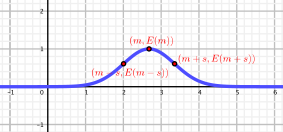
\(E\) is increasing for
\(x \lt m\) and decreasing for
\(x \gt m\text{,}\) with a local maximum at
\(x = m\text{.}\)
\(\lim_{x \to \infty} E(x) = \lim_{x \to -\infty} E(x) = 0\text{.}\)
3.5 Global optimization 3.5.5 Exercises
Answer .
Not enough information is given.
Global minimum at
\(x = b\text{.}\)
Global minimum at
\(x = a\text{;}\) global maximum at
\(x = b\text{.}\)
Not enough information is provided.
Answer .
Absolute maximum
\(p(0) = p(a) = 0\text{;}\) absolute minimum
\(p\left( \frac{a}{\sqrt{3}} \right) = -\frac{2a^3}{3\sqrt{3}}\text{.}\)
Absolute max
\(r\left( \frac{1}{b} \right) \approx 0.368 \frac{a}{b}\text{;}\) absolute min
\(r\left( \frac{2}{b} \right) \approx 0.270 \frac{a}{b}\text{.}\)
Absolute minimum
\(g(b) = a(1-e^{-b^2})\text{;}\) absolute maximum
\(g(3b) = a(1-e^{-3b^2})\text{.}\)
Absolute max
\(s\left( \frac{\pi}{2k} \right) = 1\text{;}\) absolute min
\(s\left( \frac{5\pi}{6k} \right) = \frac{1}{2}\text{.}\)
Answer .
Global maximum at
\(x=a\text{;}\) global minimum at
\(x=b\text{.}\)
Global maximum at
\(x=c\text{;}\) global minimum at either
\(x=a\) or
\(x=b\text{.}\)
Global minimum at
\(x=a\) and
\(x=b\text{;}\) global maximum somewhere in
\((a,b)\text{.}\)
Global minimum at
\(x=c\text{;}\) global maximum value at
\(x = a\text{.}\)
Answer .
Absolute max
\(s(\frac{5\pi}{12}) = 8\text{;}\) absolute min
\(s(\frac{11\pi}{12}) = 2\text{.}\)
Absolute max
\(s(\frac{5\pi}{12}) = 8\text{;}\) absolute min
\(s(0) = 5 - \frac{3\sqrt{3}}{2} \approx 2.402\text{.}\)
Absolute max
\(s(\frac{5\pi}{12}) = 8\text{;}\) absolute min
\(s(\frac{11\pi}{12}) = 2\text{.}\) (There are other points at which the function achieves these values on the given interval.)
Absolute max
\(s(\frac{5\pi}{12}) = 8\text{;}\) absolute min
\(s(\frac{5\pi}{6}) \approx 2.402\text{.}\)
3.6 Applied optimization 3.6.4 Exercises
Answer .
The absolute maximum volume is
\(V\left( \sqrt{\frac{15}{18}} \right) = \frac{15}{6}\left( \sqrt{\frac{15}{18}} \right) - \left( \sqrt{\frac{15}{18}} \right)^3 \approx 1.52145\) cubic feet.
Answer .
The maximum possible area that each of the four pens can enclose is 351562.5 square feet.
Answer .
\(172.047\) feet of cable.
Answer .
The minimum cost is $1707.27.
4 The Definite Integral 4.1 Determining distance traveled from velocity 4.1.6 Exercises
Answer .
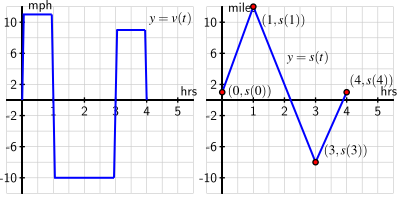
At time
\(t = 1\text{,}\) \(12\) miles north of the lake.
\(s(2) - s(0) = 1\) mile north of the lake.
Answer .
\(t = \frac{500}{32} = \frac{125}{8} = 15.625\) is when the rocket reaches its maximum height.
\(A = 3906.25\text{,}\) the vertical distance traveled on
\([0, 15.625]\text{.}\)
\(s(t) = 500t - 16t^2\text{.}\)
\(s(15.625) - s(0) = 3906.25\) is the change of the rocket’s position on
\([0,15.625]\text{.}\)
\(s(5) - s(1) = 1616\text{;}\) the rocket rose
\(1616\) feet on
\([1,5]\text{.}\)
Answer .
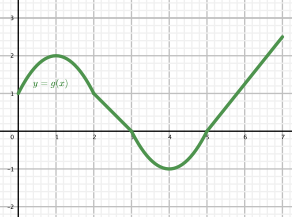
\(\frac{1}{2} + \frac{1}{4} \pi \approx 1.285\text{.}\)
\(s(5)-s(2) = -2\) is the change in position of the object on
\([2,5]\text{.}\)
On the time interval
\([5,7]\text{.}\)
\(s\) is increasing on the intervals
\((0,2)\) and
\((5,7)\text{;}\) the position function has a relative maximum at
\(t=2\text{.}\)
Answer .
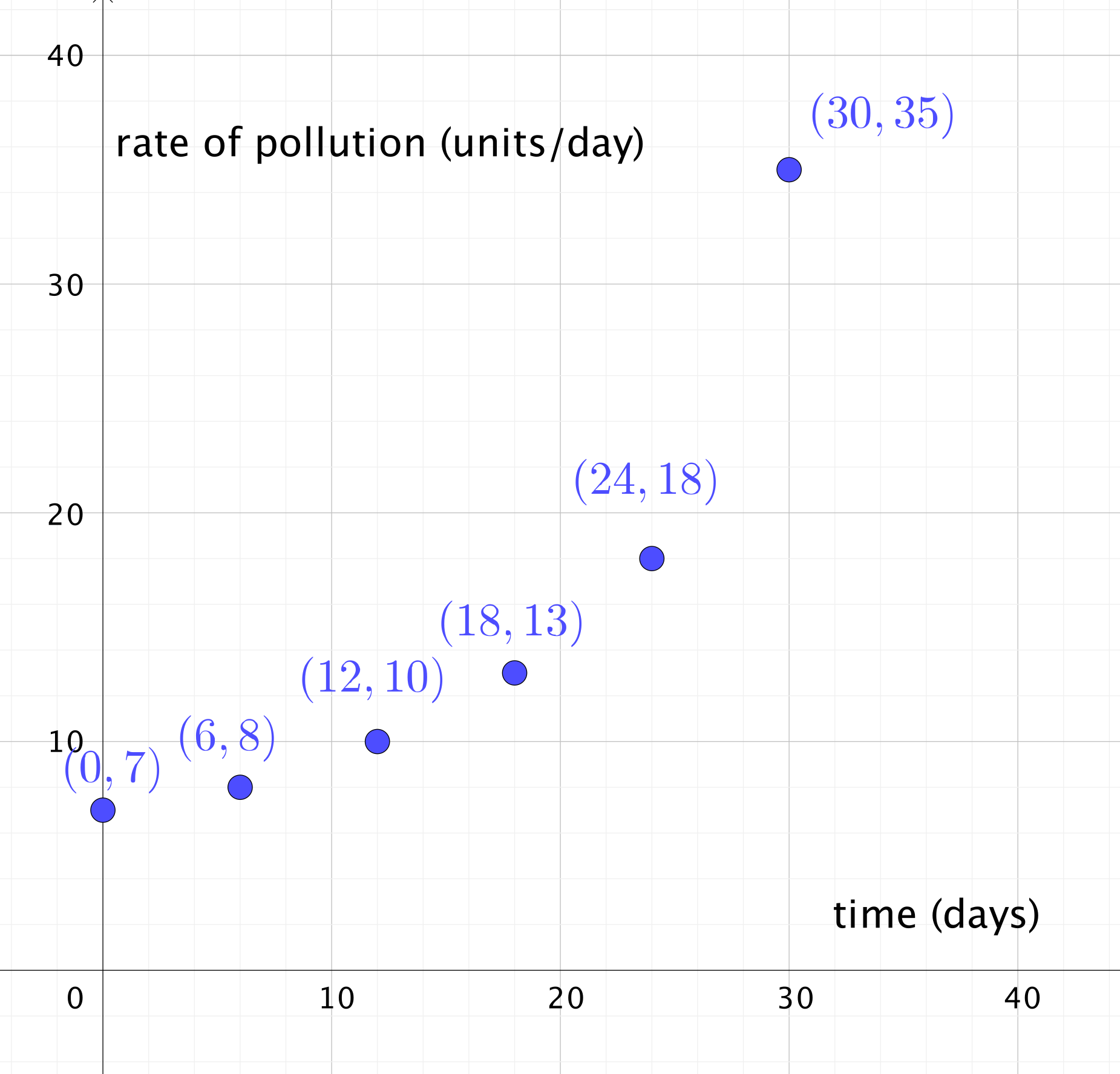
Think about the product of the units involved: “units of pollution per day” times “days”. Connect this to the area of a thin vertical rectangle whose height is given by the curve.
An underestimate is
\(336\) units of pollution.
4.2 Riemann sums 4.2.6 Exercises
Answer .
\(A = \frac{87}{2}\text{.}\)
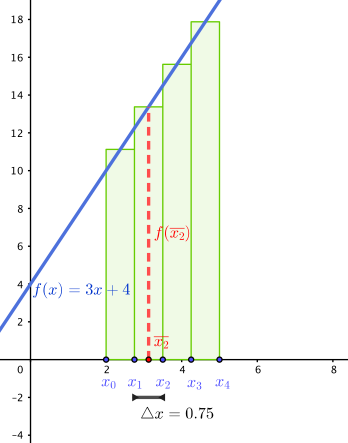
The rectangles with heights that come from the midpoint have the same area as the trapezoids that are formed by the function values at the two endpoints of each subinterval.
\(M_n\) will give the exact area for any value of
\(n\text{.}\) Neither
\(L_n\) nor
\(R_n\) will be exact for any
\(n\text{.}\)
For any linear function
\(g\) of the form
\(g(x) = mx + b\) such that
\(g(x) \ge 0\) on the interval of interest.
Answer .
\(f(x) = x^2 + 1\) on the interval
\([1,3]\text{.}\)
If
\(S\) is a left Riemann sum,
\(f(x) = x^2 + 1\) on the interval
\([1.4, 3.4]\text{.}\) If
\(S\) is a middle Riemann sum,
\(f(x) = x^2 + 1\) on the interval
\([1.2, 3.2]\text{.}\)
The area under
\(f(x) = x^2 + 1\) on
\([1,3]\text{.}\)
\(R_{10} = \sum_{i=1}^{10} \left( (1+0.2i)^2 + 1 \right) \cdot 0.2\text{.}\)
Answer .
\(L_6 = 114
\text{,}\)
\begin{equation*}
R_6 = 84\text{,}
\end{equation*}
and \(\frac{1}{2}(L_6 + R_6) = 99\text{.}\)
Answer .
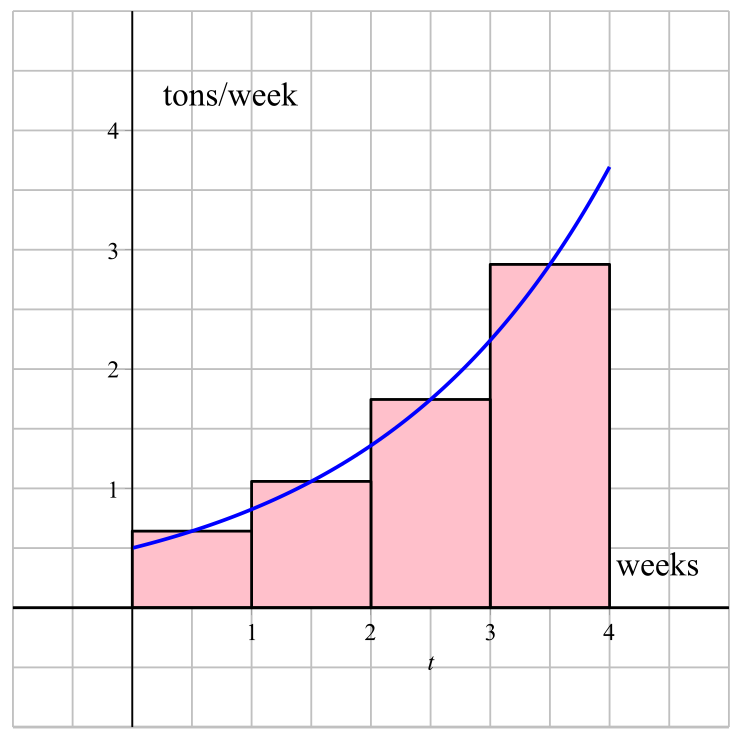
\(M_4 \approx 6.4\text{.}\)
The total tonnage of pollution escaping the scrubbing process in the time interval
\([0,4]\) weeks.
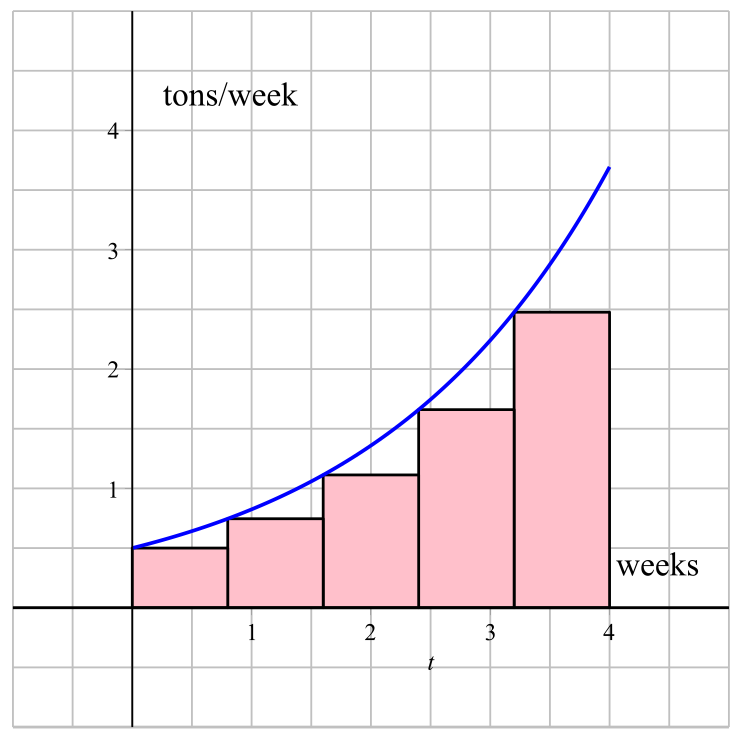
\(L_5 \approx 5.19620599\text{.}\)
4.3 The definite integral 4.3.6 Exercises
Answer .
The total change in position is
\(P = \int_0^{4} v(t) dt\text{.}\)
\(AV = -0.65625\) feet per second.
\(s(t) = -t^2+t\text{.}\)
Answer .
The total change in position,
\(P\text{,}\) is
\(P = \int_0^1 v(t) \, dt + \int_1^3 v(t) \, dt + \int_3^4 v(t) \, dt = \int_0^4 v(t) \, dt\text{.}\)
\(P = \int_0^4 v(t) \, dt \approx 2.665\text{.}\)
The total distance traveled,
\(D\text{,}\) is
\(D = \int_0^1 v(t) \, dt - \int_1^3 v(t) \, dt + \int_3^4 v(t) \, dt\text{.}\)
\(D \approx 8.00016\text{.}\)
\begin{equation*}
v_{\operatorname{AVG} [0,4]} \approx 0.66625
\end{equation*}
feet per second.
Answer .
\(\int_0^1 [f(x) + g(x)] \,dx = 1-\frac{\pi}{4}\text{.}\)
\(\int_1^4 [2f(x) - 3g(x)] \, dx = -\frac{15}{2} - 3\pi\text{.}\)
\(h_{\operatorname{AVG} [0,4]} = \frac{5}{8} + \frac{3\pi}{16}\text{.}\)
\(c = -\frac{3}{8} + \frac{3\pi}{16}\text{.}\)
Answer .
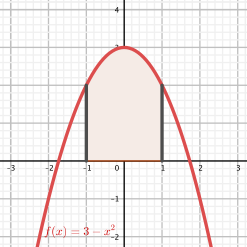
\(A_1 = \int_{-1}^{1} (3-x^2) \, dx\text{.}\)
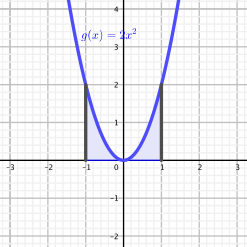
\(A_2 = \int_{-1}^{1} 2x^2 \, dx\text{.}\)
The exact area between the two curves is
\(\int_{-1}^{1} (3-x^2) \, dx - \int_{-1}^{1} 2x^2 \, dx\text{.}\)
Use the sum rule for definite integrals over the same interval.
Think about subtracting the area under
\(q\) from the area under
\(p\text{.}\)
4.4 The Fundamental Theorem of Calculus 4.4.6 Exercises
Answer .
\(\displaystyle f_{\operatorname{AVG} [0,5]} = \frac{1}{2}\text{.}\)
\(g(x) = f(x)\) for
\(0 \le x \lt 5\) and
\(g(x) = -\frac{5}{4}(x - 5)\) on
\(5 \le x \le 7\text{.}\)
Answer .
\(\displaystyle v_{\operatorname{AVG} [12,24]} = 12.5\) meters per minute.
The object’s maximum acceleration is
\(3\) meters per minute per minute at the instant
\(t = 2\text{.}\)
Answer .
\(h\) (feet)
\(0\) \(1000\) \(2000\) \(3000\) \(4000\) \(5000\) \(6000\) \(7000\) \(8000\) \(9000\) \(10{,}000\)
\(c\) (ft/min)
\(925\) \(875\) \(830\) \(780\) \(730\) \(685\) \(635\) \(585\) \(535\) \(490\) \(440\)
\(m\) (min/ft)
\(\frac{1}{925}\) \(\frac{1}{875}\) \(\frac{1}{830}\) \(\frac{1}{780}\) \(\frac{1}{730}\) \(\frac{1}{685}\) \(\frac{1}{635}\) \(\frac{1}{585}\) \(\frac{1}{535}\) \(\frac{1}{490}\) \(\frac{1}{440}\)
The antiderivative function tells the total number of minutes it takes for the plane to climb to an altitude of
\(h\) feet.
\(M = \int_{0}^{10000} m(h) \, dh
\text{.}\)
It takes the plane aabout
\(M_5 \approx 15.27\) minutes.
Answer .
\(G'(x) = \frac{1}{-x} \cdot (-1) = \frac{1}{x}\text{.}\)
Since for those values of
\(x\text{,}\) \(G'(x) = \frac{1}{x}\text{.}\)
If
\(x \lt 0\text{,}\) then
\(H(x) = \ln(|x|) = \ln(-x) = G(x)\text{;}\) if
\(x \gt 0\text{,}\) then
\(H(x) = \ln(|x|) = \ln(x) = F(x)\text{.}\)
For
\(x \lt 0\text{,}\) \(H'(x) = G'(x) = \frac{1}{x}\text{;}\) for
\(x \gt 0\text{,}\) \(H'(x) = F'(x) = \frac{1}{x}\) for all
\(x \ne 0\text{.}\)
5 Evaluating Integrals 5.1 Constructing accurate graphs of antiderivatives 5.1.6 Exercises
Answer .
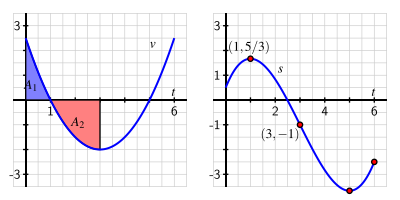
\(s(1) = \frac{5}{3}\text{,}\) \(s(3) = -1\text{,}\) \(s(5) = -\frac{11}{3}\text{,}\) \(s(6) = -\frac{5}{2}\text{.}\)
\(s\) is increasing on
\(0 \lt t \lt 1\) and
\(5 \lt t \lt 6\text{;}\) decreasing for
\(1 \lt t \lt 5\text{.}\)
\(s\) is concave down for
\(t \lt 3\text{;}\) concave up for
\(t \gt 3\text{.}\)
\(s(t) = -2t + \frac{1}{6}(t-3)^3 + 5\text{.}\)
Answer .
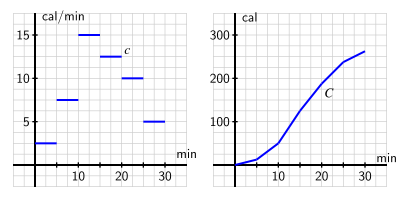
\(C\) measures the total number of calories burned in the workout since
\(t = 0\text{.}\)
\(C(5) = 12.5\text{,}\) \(C(10) = 50\text{,}\) \(C(15) = 125\text{,}\) \(C(20) = 187.5\text{,}\) \(C(25) = 237.5\text{,}\) \(C(30) = 262.5\text{.}\)
\(C(t) = 12.5 + 7.5(t-5)\) on this interval.
Answer .
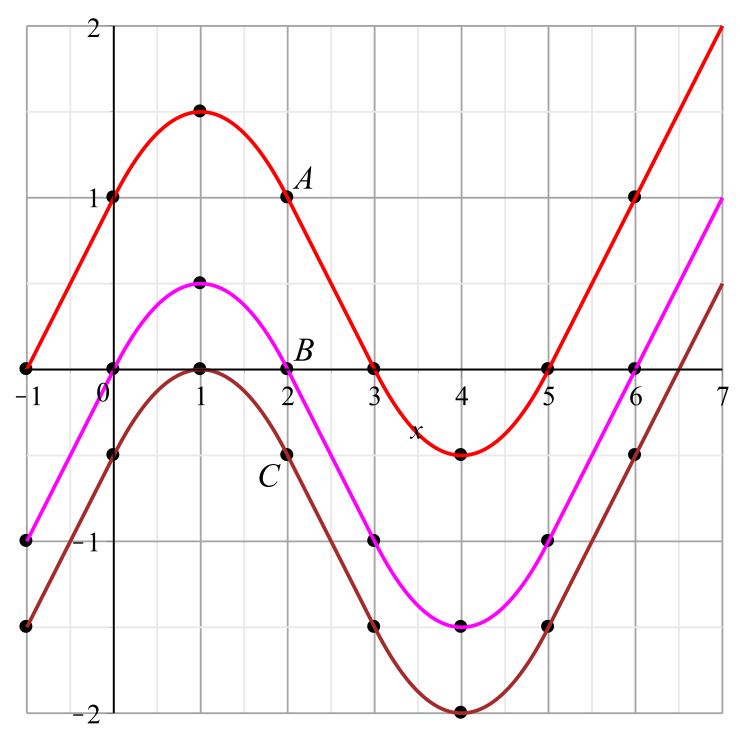
\(B(-1) = -1\text{,}\) \(B(0) = 0\text{,}\) \(B(1) = \frac{1}{2}\text{,}\) \(B(2) = 0\text{,}\) \(B(3) = -1\text{,}\) \(B(4) = -\frac{3}{2}\text{,}\) \(B(5) = -1\text{,}\) \(B(6) = 0\text{.}\) Also,
\(A(x) = 1+B(x)\) and
\(C(x) = B(x) - \frac{1}{2}\text{.}\)
\(x\) \(-1\) \(0\) \(1\) \(2\) \(3\) \(4\) \(5\) \(6\)
\(A(x)\) \(0\) \(1\) \(1.5\) \(1\) \(0\) \(-0.5\) \(0\) \(1\)
\(B(x)\) \(-1\) \(0\) \(0.5\) \(0\) \(-1\) \(-1.5\) \(-1\) \(0\)
\(C(x)\) \(-1.5\) \(-0.5\) \(0\) \(-0.5\) \(-1.5\) \(-2\) \(-1.5\) \(-0.5\)
\(A\text{,}\) \(B\text{,}\) and
\(C\) are vertical translations of each other.
5.2 The Second Fundamental Theorem of Calculus 5.2.6 Exercises
Answer .
The total sand removed on this time interval is
\begin{equation*}
\int_0^6 \left[2 + 5\sin \left( \frac{4\pi t}{25} \right) \right] \, dt\text{.}
\end{equation*}
The total amount of sand on the beach at time \(x\) is given by
\begin{equation*}
Y(x) = 2500 + \int_0^x \left[ S(t) - R(t) \right] \, dt = 2500 + \int_0^x \left[ \frac{15t}{1+3t} - \left( 2 + 5\sin \left( \frac{4\pi t}{25} \right) \right) \right] \, dt\text{.}
\end{equation*}
\(Y'(4) = S(4) - R(4) \approx -1.90875\) cubic yards per hour.
\(Y\) has an absolute minimum on
\([0,6]\) of
\(Y(5.118) \approx 2492.368\text{.}\)
Answer .
\(F\) is increasing on
\(x \lt -1\text{,}\) \(0.5 \lt x \lt 4\text{,}\) and
\(5 \lt x \lt 6.5\text{;}\) decreasing on
\(-1 \lt x \lt 0.5\) and
\(4 \lt x \lt 5\text{;}\) concave up on approximately
\(-0.4 \lt x \lt 2\) and
\(4.5 \lt x \lt 6\text{;}\) concave down on approximately
\(2 \lt x \lt 4.5\) and
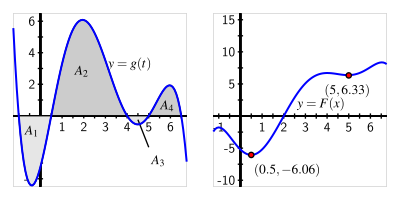
\(x \gt 6\text{;}\) \(F(2) = 0\text{;}\) \(F(0.5) = -6.06\text{;}\) \(F(-1) = -1.77\text{;}\) \(F(4) = 6.69\text{;}\) \(F(5) = 6.33\text{;}\) \(F(6.5) = 8.12\text{.}\)
Answer .
\(m(h) = \frac{1}{c(h)}\text{.}\)
\(h\) (feet)
\(0\) \(1000\) \(2000\) \(3000\) \(4000\) \(5000\) \(6000\) \(7000\) \(8000\) \(9000\) \(10{,}000\)
\(c\) (ft/min)
\(925\) \(875\) \(830\) \(780\) \(730\) \(685\) \(635\) \(585\) \(535\) \(490\) \(440\)
\(m\) (min/ft)
\(\frac{1}{925}\) \(\frac{1}{875}\) \(\frac{1}{830}\) \(\frac{1}{780}\) \(\frac{1}{730}\) \(\frac{1}{685}\) \(\frac{1}{635}\) \(\frac{1}{585}\) \(\frac{1}{535}\) \(\frac{1}{490}\) \(\frac{1}{440}\)
The antiderivative function tells us the total number of minutes that it takes for the plane to climb to an altitude of
\(h\) feet.
The number of minutes required for the airplane to ascend to \(10{,}000\) feet of altitude is given by the definite integral
\begin{equation*}
M = \int_{0}^{10000} m(h) \, dh\text{.}
\end{equation*}
The number of minutes required for the airplane to ascend to \(h\) feet of altitude is given by the definite integral
\begin{equation*}
M(h) = \int_{0}^{h} m(t) \, dt\text{.}
\end{equation*}
Estimating the desired integral using \(3\) subintervals and midpoints,
\begin{equation*}
\int_{0}^{6000} m(h) \, dh \approx 7.77\text{.}
\end{equation*}
Using \(5\) subintervals and midpoints,
\begin{equation*}
\int_{0}^{10000} m(h) \, dh \approx 15.27\text{.}
\end{equation*}
5.3 Integration by substitution 5.3.6 Exercises
Answer .
\(\int \tan(x) \, dx = \ln\left(|\sec(x)|\right) + C\text{.}\)
\(\int \cot(x) \, dx = -\ln\left(|\csc(x)|\right) + C\text{.}\)
\(\int \frac{\sec^2(x) + \sec(x) \tan(x)}{\sec(x) + \tan(x)} \, dx = \ln\left(|\sec(x) + \tan(x)|\right) + C\text{.}\)
\(\frac{\sec^2(x) + \sec(x) \tan(x)}{\sec(x) + \tan(x)} = \sec(x)\text{.}\)
\(\int \sec(x) \, dx = \ln\left(|\sec(x) + \tan(x)|\right) + C\text{.}\)
\(\int \csc(x) \, dx = -\ln\left(|\csc(x) + \cot(x)|\right) + C\text{.}\)
Answer .
\(\int x \sqrt{x-1} \, dx = \int (u+1) \sqrt{u} \, du\text{.}\)
\(\int x \sqrt{x-1} \, dx = \frac{2}{5} (x-1)^{5/2} + \frac{2}{3} (x-1)^{3/2} + C\text{.}\)
\(\int x^2 \sqrt{x-1} \, dx = \frac{2}{7} (x-1)^{7/2} + \frac{4}{5} (x-1)^{5/2} + \frac{2}{3} (x-1)^{3/2} + C\text{.}\)
\(\int x \sqrt{x^2 - 1} \, dx = \frac{1}{3} (x^2-1)^{3/2} + C\text{.}\)
Answer .
We don’t have a function-derivative pair.
\(\sin^3(x) = \sin(x) (1-\cos^2(x))\text{.}\)
\(u = \cos(x)\) and
\(du = -\sin(x) \, dx\text{.}\)
\(\int \sin^3(x) \, dx = \frac{1}{3}\cos^3(x) - \cos(x) + C\text{.}\)
\(\int \cos^3(x) \, dx = \sin(x) - \frac{1}{3}\sin^3(x) + C\text{.}\)
Answer .
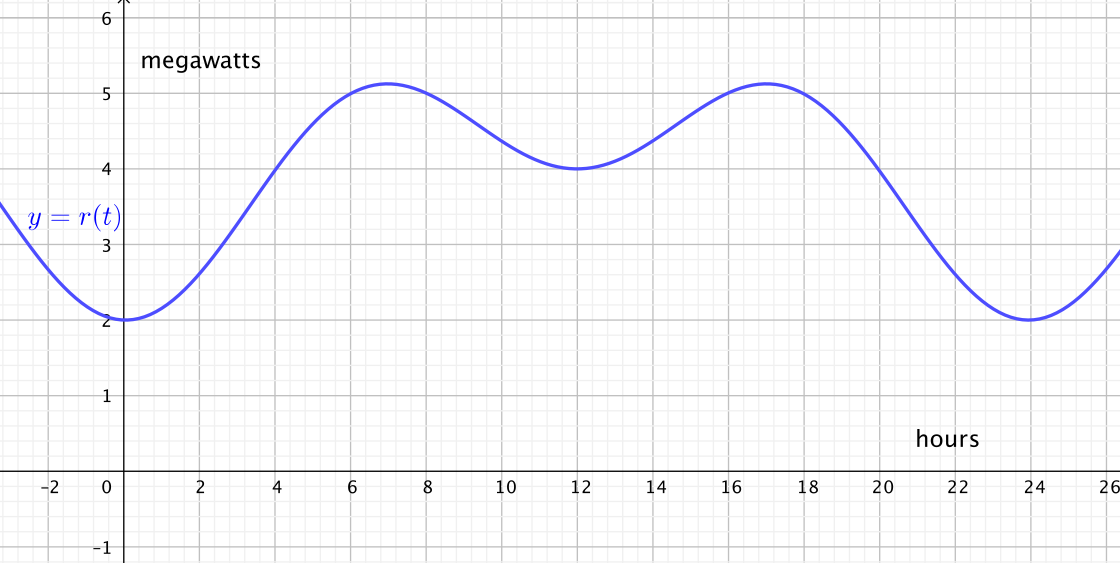
The model is reasonable because it appears to be periodic and the rate of consumption seems to peak at the times of day where people are most active in their homes.
The total energy consumed in
\(24\) hours, measured in megawatt-hours.
\(\int_0^{24} r(t) \, dt \approx 95.7809 \) megawatt-hours of power used in
\(24\) hours.
\(\displaystyle r_{\operatorname{AVG} [0,24]} \approx 3.99087\) megawatt-hours.
5.4 Integration by parts 5.4.8 Exercises
Answer .
\(F'(x) = xe^{-2x}\text{.}\)
\(\displaystyle F(x) = -\frac{1}{2}xe^{-2x} - \frac{1}{4}e^{-2x} + \frac{1}{4}\)
Answer .
\(\int e^{2x} \cos(e^x) \, dx = \int z \cos(z) \, dz\text{.}\)
\(\int e^{2x} \cos(e^x) \, dx = e^x \sin(e^x) + \cos(e^x) + C\text{.}\)
\(\displaystyle \int e^{2x} \cos(e^{2x}) \, dx = \frac{1}{2} \sin(e^{2x}) + C\)
\(\int e^{2x} \sin(e^x) \, dx = \sin(e^x) - z\cos(e^x) + C\text{.}\)
\(\int e^{3x} \sin(e^{3x}) \, dx = -\frac{1}{3} \cos(e^{3x}) + C\text{.}\)
\(\int xe^{x^2} \cos(e^{x^2}) \sin(e^{x^2}) \, dx = \frac{1}{4} \sin^2(e^{x^2}) + C\text{.}\)
Answer .
\(u\) -substitution;
\(\int x^2 \cos(x^3) \ dx = \frac{1}{3} \sin(x^3) + C\text{.}\)
Both are needed;
\(\int x^5 \cos(x^3) \ dx = \frac{1}{3} \left(x^3\sin(x^3) + \cos(x^3) \right) + C\text{.}\)
Integration by parts;
\(\int x ln(x^2) \ dx = \frac{x^2}{2} \ln(x^2) - \frac{x^2}{2} + C\text{.}\)
\(u\) -substitution;
\(\int x^3 \sin(x^4) \ dx = -\frac{1}{4} \cos(x^4) + C\text{.}\)
Both are needed;
\(\int x^7 \sin(x^4) \ dx = -\frac{1}{4} x^4 \cos(x^4) + \frac{1}{4} \sin(x^4) + C\text{.}\)
5.5 Other options for finding algebraic antiderivatives 5.5.6 Exercises
Answer .
\begin{equation*}
\int \frac{x^3 + x + 1}{x^4 - 1} \, dx = -\frac{1}{2} \arctan(x) + \frac{1}{4} \ln|x+1| + \frac{3}{4} \ln|x-1| + C
\end{equation*}
\begin{equation*}
\int \frac{x^5 + x^2 + 3}{x^3 - 6x^2 + 11x - 6} \, dx = \frac{x^3}{3} + 3x^2 + 25x + \frac{255}{2} \ln|x-3| - 39 \ln|x-2| + \frac{5}{2} \ln|x-1| + C\text{.}
\end{equation*}
\begin{equation*}
\int \frac{x^2 - x - 1}{(x-3)^3} \, dx = \ln|x-3| - \frac{5}{x-3} - \frac{5}{2(x-3)^2} + C\text{.}
\end{equation*}
Answer .
\(\int \frac{1}{x \sqrt{9x^2 + 25}} \, dx = -\frac{1}{5} \ln \left| \frac{5+\sqrt{9x^2 + 5^2}}{3x} \right| + C\text{.}\)
\(\displaystyle \int x \sqrt{1 + x^4} \, dx = \frac{1}{2} \left( \frac{x^2}{2}\sqrt{x^4 + 1} + \frac{1}{2}\ln|x^2 + \sqrt{x^4 + 1}| \right) + C\)
\(\displaystyle \int e^x \sqrt{4 + e^{2x}} \, dx = \frac{e^x}{2}\sqrt{e^{2x} + 4} + 2\ln|e^x + \sqrt{e^{2x} + 4}| + C\)
\(\int \frac{\tan(x)}{\sqrt{9 - \cos^2(x)}} \, dx = \frac{1}{3} \ln \left| \frac{3 + \sqrt{9 - \cos^2(x)}}{\cos(x)} \right| + C\text{.}\)
Answer .
Try
\(u = 1+x^2\) or
\(u = x + \sqrt{1+x^2}\text{.}\)
Try
\(u = \sqrt{x+\sqrt{1+x^2}}\) and
\(dv = \frac{1}{x} \, dx\text{.}\)
It appears that the function
\(\frac{\sqrt{x+\sqrt{1+x^2}}}{x}\) does not have an elementary antiderivative.
5.6 Numerical integration 5.6.7 Exercises
Answer .
\(u\) -substitution fails since there’s not a composite function present; try showing that each of the choices of
\(u = x\) and
\(dv = \tan(x) \, dx\text{,}\) or
\(u = \tan(x)\) and
\(dv = x \, dx\text{,}\) fail to produce an integral that can be evaluated by parts.
\(\displaystyle L_4 = 0.25892\)
\(\displaystyle R_4 = 0.64827\)
\(\displaystyle M_4 = 0.41550\)
\(\displaystyle T_4 = \frac{L_4 + R_4}{2} = 0.45360\)
\(\displaystyle S_8 = \frac{2M_4 + T_4}{3} = 0.42820\)
\(L_4\) and
\(M_4\) are underestimates;
\(R_4\) and
\(M_4\) are overestimates.
Answer .
\(\int_3^6 f(x) \approx 7.03\text{.}\)
Answer .
\(\int_0^{60} r(t) \, dt
\text{.}\)
\(\int_0^{60} r(t) \, dt \gt M_3 = 204000\text{.}\)
\(\int_0^{60} r(t) \, dt \approx S_6 = \frac{619000}{3} \approx 206333.33\text{.}\)
\(\frac{1}{60} S_6 \approx 3438.89
\text{;}\) \(\frac{2000+2100+2400+3000+3900+5100+6500}{7} = \frac{25000}{7} \approx 3571.43
\text{.}\) each estimates the average rate at which water flows through the dam on
\([0,60]\text{,}\) and the first is more accurate.
6 Using Definite Integrals 6.1 Using definite integrals to find area and length 6.1.6 Exercises
Answer .
\(A = \int_{\frac{3 - \sqrt{3}}{2}}^{\frac{3 + \sqrt{3}}{2}} -2y^2 + 6y - 3 \ dy = \sqrt{3}
\text{.}\)
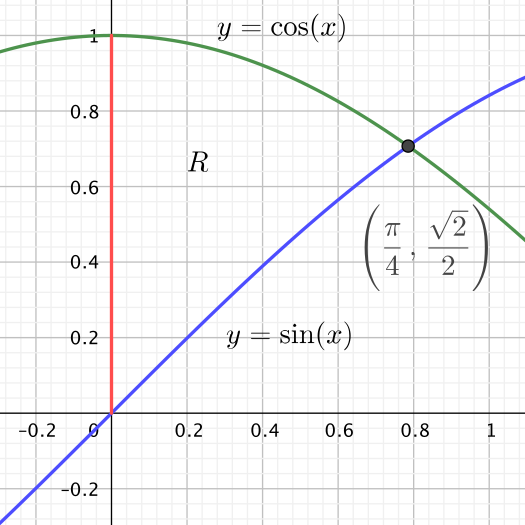
\(A = \int_{\pi/4}^{3\pi/4} \sin(x) - \cos(x) \ dx = \sqrt{2}
\text{.}\)
\(A = \int_{-1}{5/2} \frac{y+1}{2} - (y^2-y-2) \ dy = \frac{343}{48}
\text{.}\)
\(A = \int_{\frac{m - \sqrt{m^2+4}}{2}}^{\frac{m + \sqrt{m^2+4}}{2}} mx - \left(x^2-1\right) \ dx = - \frac{1}{3}\left(\frac{m + \sqrt{m^2+4}}{2}\right)^3 - \frac{1}{3}\left(\frac{m - \sqrt{m^2+4}}{2}\right)^3 + \frac{m}{2}\left(\frac{m + \sqrt{m^2+4}}{2}\right)^2 - \frac{m}{2}\left(\frac{m - \sqrt{m^2+4}}{2}\right)^2 + \left(\frac{m + \sqrt{m^2+4}}{2} - \frac{m - \sqrt{m^2+4}}{2} \right)
\text{.}\)
Answer .
\(a = \frac{1}{2}\text{.}\)
Answer .
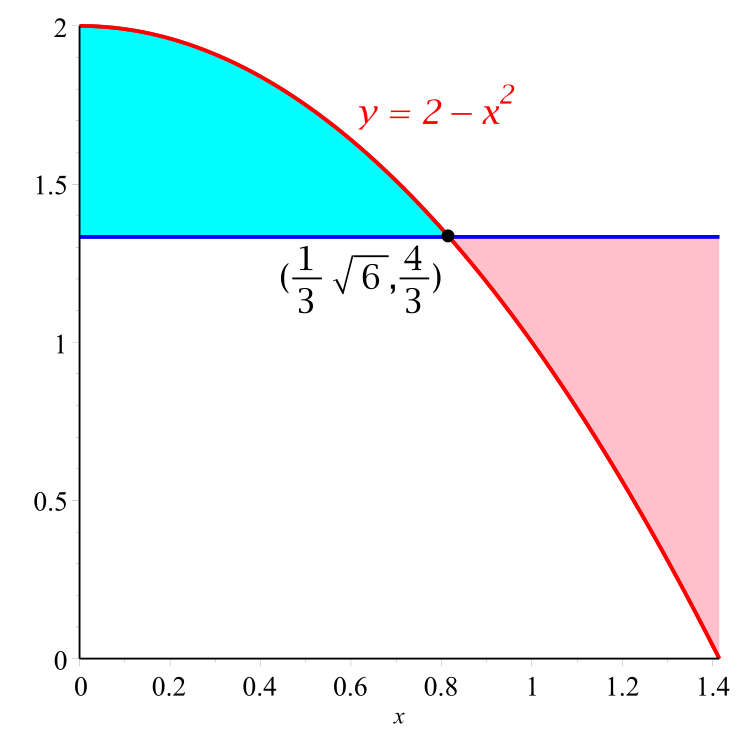
\(r = \frac{4}{3}
\text{.}\)
\(A_1 = A_2 = \frac{4 \sqrt{6}}{27}\text{.}\)
6.2 Using definite integrals to find volume 6.2.6 Exercises
Answer .
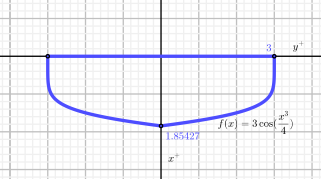
\(L = \int_0^{1.84257} \sqrt{1+\left( -3 \sin \left(\frac{x^3}{4}\right) \cdot \frac{3}{4}x^2 \right)^2} \, dx
\approx 4.10521\text{.}\)
\(A = \int_0^{1.84527} 3 \cos\left( \frac{x^3}{4} \right) \, dx \approx 4.6623
\text{.}\)
\(V = \int_0^{1.84527} \pi \cdot 9 \cos^2 \left( \frac{x^3}{4} \right) \, dx \approx 40.31965
\text{.}\)
\(V = \int_0^3 \pi \left( 4\arccos \left(\frac{y}{3} \right) \right)^{2/3} \, dy \approx 23.29194
\text{.}\)
Answer .
\(A = \int_0^{\frac{\pi}{4}} ( \cos(x) - \sin(x) ) \, dx
\text{.}\)
\(V = \int_0^{\frac{\pi}{4}} \pi (\cos^2(x) - \sin^2(x)) \, dx
\text{.}\)
\(\displaystyle V = \int_0^{\frac{\sqrt{2}}{2}} \pi \arcsin^2(y) \, dy + \int_{\frac{\sqrt{2}}{2}}^1 \pi \arccos^2(y) \, dy\)
\(V = \int_0^{\frac{\pi}{4}} \pi [(2 - \sin(x))^2 - (2 - \cos(x))^2] \, dx
\text{.}\)
\(\displaystyle V = \int_0^{\frac{\sqrt{2}}{2}} \pi [ (1+\arcsin(y))^2 - 1^2 ] \, dy + \int_{\frac{\sqrt{2}}{2}}^1 \pi [ (1+\arccos(y))^2 - 1^2 ] \, dy\)
Answer .
\(A = \int_0^{1.5} 1+\frac{1}{2}(x-2)^2 - \frac{1}{2}x^2 \ dx = 2.25\text{.}\)
\(\displaystyle V = \int_0^{1.5} \pi\left[\left(2+\frac{1}{2}(x-2)^2\right)^2 - \left(1+\frac{1}{2}x^2\right)^2 \right] \ dx = \frac{315}{32} \pi\)
\(V = \int_{0}^{1.125} \pi \left(\sqrt{2y}\right)^2 \ dy + \int_{1.125}^3 \pi \left(2 - \sqrt{2(y-1)}\right)^2 \ dy \approx 7.06858347
\text{.}\)
\(P = 3 + \int_0^{1.5} \sqrt{1+(x-2)^2} + \sqrt{1+x^2} \ dx \approx 7.387234642
\text{.}\)
6.3 Density, mass, and center of mass 6.3.6 Exercises
Answer .
\(a = -10 \ln(0.7) \approx 3.567 \text{ cm}\text{.}\)
\(\overline{x} \approx \frac{50.3338}{30} \approx 1.687\text{.}\)
\(q = -10\ln(0.85) \approx 1.625\) cm.
Answer .
\(M_1 = \arctan(10) \approx 1.47113\text{;}\) \(M_2 = 10 - 10e^{-1} \approx 6.32121\text{.}\)
\(\overline{x_1} \approx 1.56857
\text{;}\) \(\overline{x_2} \approx 4.18023
\text{.}\)
\begin{equation*}
M = \int_0^{10} \rho(x) \, dx + \int_0^{10} p(x) \, dx \approx 1.47113 + 6.32121 = 7.79234\text{.}
\end{equation*}
\begin{equation*}
\int_0^{10} x(\rho(x) + p(x))) \, dx = 28.73167\text{.}
\end{equation*}
Answer .
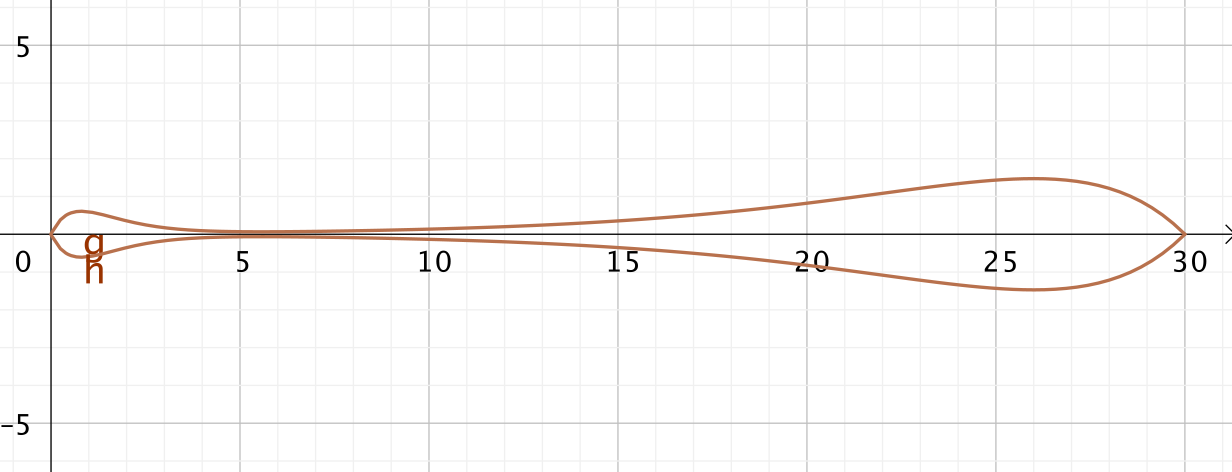
\(V = \int_0^{30} \pi (2xe^{-1.25x} + (30-x) e^{-0.25(30-x)})^2 \, dx \approx 52.0666\) cubic inches.
\(W \approx 0.6 \cdot 52.0666 = 31.23996\) ounces.
At a given
\(x\) -location, the amount of weight concentrated there is approximately the weight density (
\(0.6\) ounces per cubic inch) times the volume of the slice, which is
\(V_{text{slice}} \approx \pi f(x)^2\text{.}\)
\(\displaystyle \overline{x} \approx 23.21415\)
6.4 Physics applications: work, force, and pressure 6.4.6 Exercises
Answer .
\(W \approx 1353.55\) foot-pounds.
\(W = \int_0^h 3744 x \cos \left( \frac{x^3}{4} \right) \, dx
\text{.}\)
\(F \approx 462.637\) pounds.
Answer .
\(W = 1404(19\pi - 8) \approx 305179.3 \) foot-pounds.
\begin{equation*}
F \approx 1123.2
\end{equation*}
pounds.
6.5 Improper integrals 6.5.6 Exercises
Answer .
Converges to
\(1\text{.}\)
\(\int_e^{\infty} \frac{1}{x(\ln(x))^p} \, dx\) diverges if
\(p \leq 1\) and converges to
\(\frac{1}{p-1}\) if
\(p \gt 1\text{.}\)
Converges to
\(-1\text{.}\)
7 Differential Equations 7.1 An introduction to differential equations 7.1.6 Exercises
Answer .
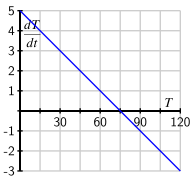
\(\frac{dT}{dt}\vert_{T=105} = -2\text{;}\) when
\(T = 105\text{,}\) the coffee’s temperature is decreasing at an instantaneous rate of
\(-2\) degrees F per minute.
\(T\) decreasing at
\(t=0\text{.}\)
\(T(1) \approx 103\) degrees F.
For
\(T \lt 75\text{,}\) \(T\) increases. For
\(T \gt 75\text{,}\) \(T\) decreases.
Room temperature is
\(75\) degrees F.
Substitute
\(T(t) = 75 + 30e^{-t/15}\) in for
\(T\) in the differential equation
\(\frac{dT}{dt}= -\frac1{15}T+5\) and verify the equality holds;
\(T(0) = 75 + 30e^0 = 75 + 30 = 105\text{;}\) \(T(t) = 75 + 30e^{-t/15} \to 75\) as
\(t \to \infty\text{.}\)
Answer .
\(y(t) = t + 1 + 2e^t\) is a solution to the DE.
\(y(t) = t + 1\) is a solution to the DE.
\(y(t) = t + 2\) is a not solution to the DE.
Answer .
\(1 \lt P \lt 3\text{.}\)
\(P \lt 1\) and
\(3 \lt P \lt 4\text{.}\)
\(P\) will not change at all.
The population will decrease toward
\(P = 0\) with
\(P\) always being positive.
The population will increase toward
\(P = 3\) with
\(P\) always being between
\(1\) and
\(3\text{.}\)
The population will decrease toward
\(P = 3\) with
\(P\) always being above
\(3\text{.}\)
There’s a maximum threshold of
\(P = 3\text{.}\)
7.2 Qualitative behavior of solutions to differential equations 7.2.5 Exercises
Answer .
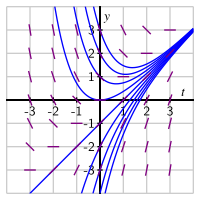
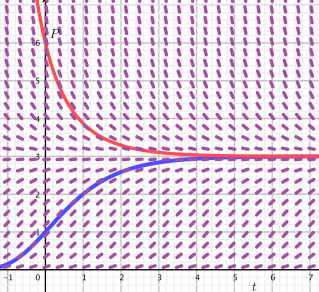
Sketch curves through appropriate points in the slope field above.
\(t\) and
\(y\) are equal.
Answer .
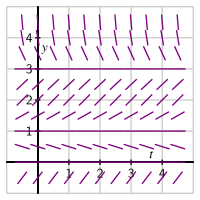
Any solution curve that starts with
\(P(0) \gt 3\) will decrease to
\(P(t) = 3\) as
\(t \to \infty\text{;}\) any curve that starts with
\(1 \lt P(0) \lt 3\) will increase to
\(P(t) = 3\text{;}\) any curve that starts with
\(0 \lt P(0) \lt 1\) will decrease to
\(P(t) = 0\text{.}\)
\(P = 0\text{,}\) \(P = 1\text{,}\) and
\(P = 3\text{.}\) \(P = 1\) is unstable;
\(P = 0\) and
\(P = 3\) are stable.
The population will stabilize either at the value
\(P = 3\) or at
\(P = 0\text{.}\)
\(P(t) = 1\) is the threshold.
Answer .
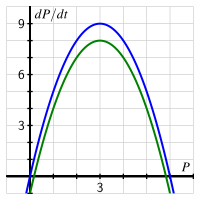
A graph of
\(f\) against
\(P\) is given in blue in the figure below. The equilibrium solutions are
\(P=0\) (unstable) and
\(P=6\) (stable).
\(\frac{dP}{dt} = g(P) = P(6-P)-1\) ; the equilibrium at
\(P\approx 0.172\) is unstable; the equilibrium at
\(P \approx 5.83\) is stable.
If
\(P \lt \frac{6-\sqrt{32}}{2}\text{,}\) then the fish population will die out. If
\(\frac{6-\sqrt{32}}{2} \lt P\text{,}\) then the fish population will approach
\(\frac{6+\sqrt{32}}{2}\) thousand fish.
\(\frac{dP}{dt} = g(P) = P(6-P)-h
\text{;}\) equilibrium solutions
\(P = \frac{6+\sqrt{36-4h}}{2}, \ \frac{6-\sqrt{36-4h}}{2}
\text{.}\)
\(9000\) fish; harvesting at that rate will maintain the number of fish we start with, provided it’s at least
\(3000\text{.}\)
Answer .
\(\frac{dy}{dt} = 20y\text{.}\)
\(\displaystyle \frac{dy}{dt} = 20y - C\frac{y}{2+y}\)
For positive
\(y\) near
\(0\text{,}\) \(M(y) = \frac{y}{2+y} \approx 0\text{;}\) for large values of
\(y\text{,}\) \(M(y) = \frac{y}{2+y} \approx 1\text{.}\)
The only equilibrium solution is
\(y = 0\text{,}\) which is unstable.
The equilibrium solutions are
\(y = 0\) (stable) and
\(y = 1\) (unstable).
7.3 Euler’s method 7.3.5 Exercises
Answer .
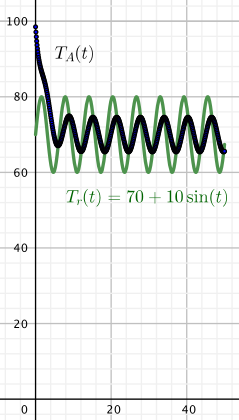
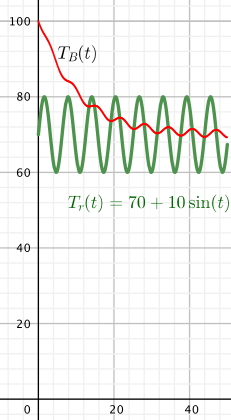
Alice’s coffee:
\(\frac{dT_A}{dt} \vert_{T = 100} = -0.5(30) = -15\) degrees per minute; Bob’s coffee:
\(\frac{dT_B}{dt} \vert_{T = 100} = -0.1(30) = -3\) degrees per minute.
Consider the insulation of the containers.
Alice’s coffee:
\begin{equation*}
\frac{dT_A}{dt} = -0.5(T_A-(70+10\sin t))\text{,}
\end{equation*}
with the inital condition \(T_A(0) = 100\text{.}\)
\(t\) \(T_A(t)\)
\(0.0\) \(100\)
\(0.1\) \(98.5\)
\(0.2\) \(97.12492\)
\(0.3\) \(95.86801\)
\(0.4\) \(94.72237\)
\(\vdots\) \(\vdots\)
\(49.6\) \(65.56715\)
\(49.7\) \(65.48008\)
\(49.8\) \(65.43816\)
\(49.9\) \(65.44183\)
\(50\) \(65.49103\)
\(t\) \(T_A(t)\)
\(0.0\) \(100\)
\(0.1\) \(99.7\)
\(0.2\) \(99.41298\)
\(0.3\) \(99.13872\)
\(0.4\) \(98.87689\)
\(\vdots\) \(\vdots\)
\(49.6\) \(69.39515\)
\(49.7\) \(69.33946\)
\(49.8\) \(69.29248\)
\(49.9\) \(69.25467\)
\(50\) \(69.22638\)
Compare the rate of initial decrease and amplitude of oscillation.
Answer .
\(K = 1.054\text{;}\) \(y(1) = 2.6991\text{.}\)
\(K = 1.272\text{;}\) \(y(1) = 2.7169\text{.}\)
\(K = 0.122\) and
\(y(0.3) = 0.0412\text{.}\)
Answer .
\(y(1) \approx y_5 = 2.7027\text{.}\)
\(y(1) \approx y_{10} = 2.7141\text{.}\)
The square of
\(\Delta t\text{.}\)
7.4 Separable differential equations 7.4.4 Exercises
Answer .
\(\frac{dM}{dt} = kM
\text{.}\)
\(M(t) = M_0e^{kt}
\text{.}\)
\(\displaystyle M(t) = M_0e^{-\frac{\ln(2)}{5730}t} \approx M_0e^{-0.000121t}\)
\(t = \frac{5730\ln(4)}{\ln(2)} \approx 11460\) years.
\(t = -\frac{5730\ln(0.3)}{\ln(2)} \approx 9952.8\) years.
Answer .
\(y = \sqrt{64 - t^2}
\text{.}\)
\(-8 \le t \le 8\text{.}\)
\(\frac{dy}{dt} = -\frac ty\) is not defined when
\(y = 0\text{.}\)
Answer .
\(\frac{dh}{dt} = k \sqrt{h}
\text{.}\)
The tank with
\(k = -10\) has water leaving the tank much more rapidly.
\(h(t) = \left( 10 - t \right)^2
\text{.}\)
Answer .
\(P(t) = 3e^{\ln \left(\frac{1}{3} \right) e^{-t}}
\text{.}\)
\(P(t) = 3e^{\ln \left( 2 \right) e^{-t}}
\text{.}\)
7.5 Modeling with differential equations 7.5.4 Exercises
Answer .
\(\displaystyle \frac{dA}{dt} = 1 + 0.05A\)
\(A(25) = 49.80686\) million dollars.
\(A(25) = 34.90343\) million dollars.
\(t = 20 \ln(2) \approx 13.86 \ \text{years}
\text{.}\)
Answer .
\(\displaystyle \frac{dv}{dt} = 9.8 - kv\)
\(v = \frac{9.8}{k}\) is a stable equilibrium.
\(\displaystyle v(t) = \frac{9.8 - 9.8e^{-kt}}{k}\)
\(k = 9.8/54 \approx 0.181481\text{.}\)
\(t = \frac{\ln(0.5)}{-0.181481} \approx 3.1894\) seconds.
Answer .
\(\frac{dw}{dt} = \frac{k}{w}
\text{.}\)
\(w(t) = \sqrt{17t+64}
\text{;}\) \(w(12) = \sqrt{268} \approx 16.37\) pounds.
The model is unrealistic.
Answer .
The inflow and outflow are at the same rate.
\(\displaystyle \frac{S(t)}{100} \frac{\text{grams}}{\text{gallon}}\)
\(\frac{3S(t)}{100} \frac{\text{grams}}{\text{minute}}
\text{.}\)
\(\frac{dS}{dt} = 60 - \frac{3}{100} S
\text{.}\)
\(S = 2000\) is a stable equilibrium solution.
\(S(t) = 2000 - 2000e^{-\frac{3}{100}t}
\text{.}\)
\(S(t) \to 2000\text{.}\)
7.6 Population growth and the logistic equation 7.6.5 Exercises
Answer .
\(p(t) \to 1\) as
\(t \to \infty\) provided
\(p(0) \gt 0\text{.}\)
\(p(t) = \frac{1}{9e^{-0.2t} + 1}
\text{.}\)
\(t = -5 \ln(1/9) \approx 10.986\) days.
\(t = -5 \ln(0.25/9) \approx 17.19\) days.
Answer .
\(\displaystyle \frac{db}{dt} = \frac{1}{3000} b(15000 - b)\)
When
\(b = 7500\text{.}\)
\(t = -\frac{1}{5} \ln(1/70) \approx 0.8497\) days.
Answer .
\(\frac{dP}{dt} = 0.1P(10 - P) - 0.2P
\text{.}\)
\(P(1) \approx 8.7899\) thousand fish.
\(t = -1.25 \ln(5/11) \approx 0.986\) years.
8 Taylor Polynomials and Taylor Series 8.1 Extending local linearization 8.1.6 Exercises
Answer .
\(f(x)=\) \(\frac{1}{3}x^3 + \frac{1}{4}x^2 - 2x - 1\)
\(f'(x)=\) \(x^2 + \frac{1}{2}x - 2\)
\(f''(x)=\) \(2x + \frac{1}{2}\)
\(f(0)=\) \(-1\)
\(f'(0)=\) \(-2\)
\(f''(0)=\) \(\frac{1}{2}\)
See the bottom half of the table in the previous item.
\(T_1(x) = -1 - 2x\text{.}\)
\(f(x)=\) \(\frac{1}{3}x^3 + \frac{1}{4}x^2 - 2x - 1\) \(T_2(x)=\) \(c_0 + c_1 x + c_2 x^2\)
\(f'(x)=\) \(x^2 + \frac{1}{2}x - 2\) \(T_2'(x)=\) \(c_1 + 2 c_2 x\)
\(f''(x)=\) \(2x + \frac{1}{2}\) \(T_2''(x)=\) \(2 c_2\)
\(f(0)=\) \(-1\) \(T_2(0)=\) \(c_0\)
\(f'(0)=\) \(-2\) \(T_2'(0)=\) \(c_1\)
\(f''(0)=\) \(\frac{1}{2}\) \(T_2''(0)=\) \(2c_2\)
\(\displaystyle T_2(x) = \frac{1}{4}x^2 - 2x - 1\)
\(T_2(x)\) is a better approximation of
\(f(x)\) than
\(T_1(x)\) and is better on a wider interval.
Answer .
\(f(x)=\) \(\frac{1}{3}x^3 + \frac{1}{4}x^2 - 2x - 1\) \(T_3(x)=\) \(k_0 + k_1 x + k_2 x^2 + k_3 x^3\)
\(f'(x)=\) \(x^2 + \frac{1}{2}x - 2\) \(T_3'(x)=\) \(k_1 + 2 k_2 x + 3 k_3 x^2\)
\(f''(x)=\) \(2x + \frac{1}{2}\) \(T_3''(x)=\) \(2 k_2 + 6k_3 x\)
\(f'''(x)=\) \(2\) \(T_3'''(x)=\) \(6k_3\)
\(f(0)=\) \(-1\) \(T_3(0)=\) \(k_0\)
\(f'(0)=\) \(-2\) \(T_3'(0)=\) \(k_1\)
\(f''(0)=\) \(\frac{1}{2}\) \(T_3''(0)=\) \(2k_2\)
\(f'''(0)=\) \(2\) \(T_3''(0)=\) \(6k_3\)
\(T_3(x) = \frac{1}{3}x^3 + \frac{1}{4}x^2 - 2x - 1\text{.}\)
\(T_3(x) = f(x)\) so
\(T_3(x)\) is identical to the original function.
\(T_4(x) = T_3(x) = f(x)\text{.}\)
That the degree
\(6\) approximation will be the original polynomial function itself.
8.2 Taylor polynomials 8.2.5 Exercises
Answer .
\(T_4(x) = 2 - 3x - \frac{1}{2!}x^2 - \frac{3}{4!}x^4\text{.}\)
\(f(0.5) \approx T_4(0.5) = 2 - 3 \cdot 0.5 - \frac{1}{2!}(0.5)^2 - \frac{3}{4!}(0.5)^4 = 0.3671875
\text{.}\)
From \(T_4(x)\text{,}\) it follows
\begin{align*}
T_3(x) =\mathstrut \amp 2 - 3x - \frac{1}{2!}x^2 + 0x^3\\
T_2(x) =\mathstrut \amp 2 - 3x - \frac{1}{2!}x^2\\
T_1(x) =\mathstrut \amp 2 - 3x\text{.}
\end{align*}
Answer .
\(\displaystyle T_2(x) = 3 + 0(x-2) + \frac{1}{2!}(x-2)^2\)
\(f(x) = T_2(x)\text{.}\)
\((2,3)\) is the vertex of the quadratic function
\(f(x)\text{.}\)
\(L(x) = T_1(x) = 3\text{,}\) so
\(f\) has a horizontal tangent line at
\(x = 2\text{,}\) which corresponds to its global minimum at
\(x = 2\text{.}\)
Answer .
\(\displaystyle T_6(x) = 1 - \frac{1}{2!}(x-\frac{1}{2})^2 + \frac{1}{4!}(x-\frac{1}{2})^4 - \frac{1}{6!}(x-\frac{1}{2})^6\)
\(T_6(x)\) appears to be the same as
\(P_6(x-\frac{\pi}{2})\text{,}\) the degree
\(6\) Taylor polynomial of
\(\cos(x)\) centered at
\(a = 0\text{,}\) shifted
\(\frac{\pi}{2}\) units to the right.
Since
\(\sin(x) = \cos(x - \frac{\pi}{2})\text{,}\) this tells us that the sine function is simply a shifted version of the cosine function (the cosine function shifted
\(\frac{\pi}{2}\) units to the right).
Answer .
\(\ln(1.5) = f(0.5) \approx T_5(0.5) = 1(0.5) - \frac{1}{2}(0.5)^2 + \frac{1}{3}(0.5)^3 - \frac{1}{4}(0.5)^4 + \frac{1}{5}(0.5)^5 = 0.4072916\overline{6}\text{.}\)
\(\ln(1.5) = g(1.5) \approx P_5(1.5) = 1(1.5-1) - \frac{1}{2}(1.5-1)^2 + \frac{1}{3}(1.5-1)^3 - \frac{1}{4}(1.5-1)^4 + \frac{1}{5}(1.5-1)^5 = 0.4072916\overline{6}\text{.}\)
The same. This occurs because
\(f(x) = g(1+x)\text{.}\)
8.3 Geometric sums 8.3.6 Exercises
Answer .
For
\(S_n = 1 + 1 + \cdots + 1
\text{,}\)
\(S_2 = 1 + 1 = 2\text{,}\) \(S_3 = 1 + 1 + 1 = 3\text{,}\) \(S_4 = 4\text{,}\) and
\(S_n = n\text{.}\)
The infinite sum
\(S = 1 + 1 + \cdots + 1 + \cdots\) diverges.
For
\(S_n = 1 - 1 + 1 - 1 + \cdots + (-1)^{n-1}
\text{,}\)
\(S_2 = 1 - 1 = 0\text{,}\) \(S_3 = 1 - 1 + 1 = 1\text{,}\) \(S_4 = 1 - 1 + 1 - 1 = 0\text{,}\) \(S_5 = 1 - 1 + 1 - 1 + 1 = 1\text{,}\) and
\(S_n = 0\) when
\(n\) is even, and
\(S_n = 1\) when
\(n\) is odd.
The infinite sum
\(S = 1 - 1 + 1 - 1 + \cdots + 1 - 1 + \cdots\) diverges.
For
\(S_n = 1 + 2 + 4 + \cdots + 2^{n-1}
\text{.}\)
\(S_2 = \frac{1-2^2}{-1} = 3\text{,}\) \(S_3 = \frac{1-2^3}{-1} = 7\text{,}\) and
\(S_4 = \frac{1-2^4}{-1} = 15\text{,}\) so
\(S_n = 2^n - 1\text{.}\)
The infinite geometric series
\(1 + 2 + 4 + \cdots + 2^{n-1} + \cdots\) diverges.
Answer .
\(h_1 = \left(\frac{3}{4}\right)h
\text{.}\)
\(h_2 = \left(\frac{3}{4}\right)h_1 = \left(\frac{3}{4}\right)^2h
\text{.}\)
\(h_3 = \left(\frac{3}{4}\right)h_2 = \left(\frac{3}{4}\right)^3h
\text{.}\)
\(h_n = \left(\frac{3}{4}\right)h_{n-1} = \left(\frac{3}{4}\right)^nh
\text{.}\)
The distance traveled by the ball is
\(7h\text{,}\) which is finite.
Answer .
\(30 \cdot 500 = 1500\) dollars.
Day
Pay on this day
Total amount paid to date
\(1\) \(\dollar0.01\) \(\dollar0.01\)
\(2\) \(\dollar0.02\) \(\dollar0.03\)
\(3\) \(\dollar0.04\) \(\dollar0.07\)
\(4\) \(\dollar0.08\) \(\dollar0.15\)
\(5\) \(\dollar0.16\) \(\dollar0.31\)
\(6\) \(\dollar0.32\) \(\dollar0.63\)
\(7\) \(\dollar0.64\) \(\dollar1.27\)
\(8\) \(\dollar1.28\) \(\dollar2.55\)
\(9\) \(\dollar2.56\) \(\dollar5.11\)
\(10\) \(\dollar5.12\) \(\dollar10.23\)
\(\dollar0.01\left(2^{30}-1\right) = \dollar10,737,418.23
\text{.}\)
8.4 Taylor series 8.4.5 Exercises
Answer .
\(T_4(x) = 0 - 1 \left(x - \frac{\pi}{2}\right) + \frac{0}{2!}\left(x - \frac{\pi}{2}\right)^2 + \frac{1}{3!}\left(x - \frac{\pi}{2}\right)^3 + \frac{0}{4!}\left(x - \frac{\pi}{2}\right)^4
\text{;}\) \(T(x) = 0 - 1 \left(x - \frac{\pi}{2}\right) + \frac{0}{2!}\left(x - \frac{\pi}{2}\right)^2 + \frac{1}{3!}\left(x - \frac{\pi}{2}\right)^3 + \frac{0}{4!}\left(x - \frac{\pi}{2}\right)^4 + \cdots + (-1)^{n+1} \frac{1}{(2n+1)!}\left(x - \frac{\pi}{2}\right)^{2n+1} + \cdots
\text{;}\) think about the Taylor series centered at
\(a = 0\) for
\(g(x) = \sin(x)\) and note that
\(f(x) = \cos(x) = -\sin\left( x - \frac{\pi}{2} \right) = -g\left( x - \frac{\pi}{2} \right) \text{.}\)
\(T_4(x) = \frac{1}{2} - \frac{1}{2^2}(x-1) + \frac{1}{2^3}(x-1)^2 - \frac{1}{2^4}(x-1)^3 + \frac{1}{2^5}(x-1)^4
\text{;}\) \(T(x) = \frac{1}{2} - \frac{1}{2^2}(x-1) + \frac{1}{2^3}(x-1)^2 - \frac{1}{2^4}(x-1)^3 + \frac{1}{2^5}(x-1)^4 + \cdots + \frac{1}{2^{n+1}}(x-1)^{n} + \cdots
\text{.}\)
Answer .
\(P_4(x) = x^2
\text{.}\)
\(g(x) = T(x^2) = x^2 - \frac{1}{3!}x^6 + \frac{1}{5!}x^{10} - \cdots
\text{.}\)
8.5 Finding and using Taylor series 8.5.5 Exercises
Answer .
\(C(x) = x - \frac{1}{5 \cdot 2!}x^5 + \frac{1}{9 \cdot 4!}x^9 - \frac{1}{13 \cdot 6!}t^{13} + \cdots
\text{.}\)
For all real numbers
\(x\text{.}\)
\(C(0.5) \approx \frac{1}{2} - \frac{1}{5 \cdot 2! \cdot 2^5} = \frac{159}{320} = 0.496875
\text{,}\) which is accurate to within
\(\frac{1}{9 \cdot 4! \cdot 2^9} = \frac{1}{110592} = 0.00000904 \ldots\text{.}\)
\(S(x) = \frac{1}{3}x^3 - \frac{7 \cdot 3!}x^7 + \frac{1}{11 \cdot 5!}x^{11} - \cdots
\text{.}\)
For all real numbers
\(x\text{.}\)
\(S(0.8) \approx \frac{1}{3} \left( \frac{4}{5} \right)^3 - \frac{1}{7 \cdot 3!} \left( \frac{4}{5} \right)^7 = \frac{271808}{1640625} = 0.16567 \ldots
\text{,}\) which is accurate to within
\(\frac{1}{11 \cdot 5!} \left( \frac{4}{5} \right)^{11} = 0.00006507 \ldots\text{.}\)
Answer .
Both series expanstions for
\(e^x\) have “
\(1\) ” as their constant term, and thus
\(a_1 = a_0 = 1\text{.}\)
By equating the coefficients of the linear terms
\(a_1 x\) and
\(2a_2 x\text{,}\) it follows
\(a_1 = 2a_2\text{.}\)
\(a_3 = \frac{1}{3}a_2 = \frac{1}{3 \cdot 2} = \frac{1}{3!}\text{,}\) \(a_4 = \frac{1}{4}a_3 = \frac{1}{4 \cdot 3!} = \frac{1}{4!}\text{,}\) and
\(a_5 = \frac{1}{5}a_4 = \frac{1}{5 \cdot 4!} = \frac{1}{5!}\text{;}\) so in general,
\(a_k = \frac{1}{k!}\text{.}\)
8.6 Quantifying the accuracy of approximations 8.6.5 Exercises
Answer .
\(\int_0^1 \frac{4}{1+x^2} \, dx = 4 - \frac{4}{3} + \frac{4}{5} - \frac{4}{7} + \cdots
\text{.}\)
It would take
\(n = 200\) terms in the sum to get an approximation within
\(0.01\text{.}\)
\(\int_0^1 \frac{4}{1+x^2} \, dx = \left. 4 \arctan(x) \right|_0^1 = \pi
\text{.}\)
\(\pi = 4 - \frac{4}{3} + \frac{4}{5} - \frac{4}{7} + \cdots\text{;}\) \(200\) terms are needed to be accurate to
\(2\) decimal places.
9 Supplementary material 9.1 Review of Prerequsites for Calculus I
Exercises
9.2 Review of Prerequsites for Calculus II
Exercises
9.3 Integrating Rational Functions 9.3.2 Exercises
9.4 Integration with Trigonometric Functions 9.4.2 Exercises
9.5 Parametric Curves
Exercises
9.6 Calculus in Polar Coordinates
Exercises
{% if show_ethical_ad %}{% endif %}