The growth of the earth’s population has long been an important issue for humankind. Will the population continue to grow? Or will it perhaps level off at some point, and if so, when? In this section, we look at two ways we may use differential equations to help us address these questions.
On the face of it, this seems pretty reasonable. When there is a relatively small number of people, there will be fewer births and deaths so the rate of change will be small. When there is a larger number of people, there will be more births and deaths so we expect a larger rate of change. If \(P(t)\) is the population \(t\) years after the year 2000, we may express this assumption as
Our work in Activity 7.6.2 shows that that the exponential model is fairly accurate for years relatively close to 2000. However, if we go too far into the future, the model predicts increasingly large rates of change, which causes the population to grow arbitrarily large. This does not make much sense since it is unrealistic to expect that the earth would be able to support such a large population.
The constant \(k\) in the differential equation has an important interpretation. Let’s rewrite the differential equation \(\frac{dP}{dt} = kP\) by solving for \(k\text{,}\) so that we have
\begin{equation*}
k = \frac{dP/dt}{P}\text{.}
\end{equation*}
We see that \(k\) is the ratio of the rate of change to the population; in other words, it is the contribution to the rate of change from a single person. We call this the per capita growth rate.
In the exponential model we introduced in Activity 7.6.2, the per capita growth rate is constant. This means that when the population is large, the per capita growth rate is the same as when the population is small. It is natural to think that the per capita growth rate should decrease when the population becomes large, since there will not be enough resources to support so many people. We expect it would be a more realistic model to assume that the per capita growth rate depends on the population \(P\text{.}\)
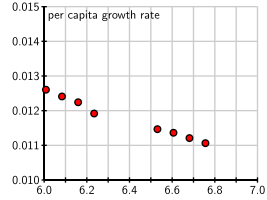
In the previous activity, we computed the per capita growth rate in a single year by computing \(k\text{,}\) the quotient of \(\frac{dP}{dt}\) and \(P\) (which we did for \(t = 0\)). If we return to the data in Table 7.6.2 and compute the per capita growth rate over a range of years, we generate the data shown in Figure 7.6.3, which shows how the per capita growth rate is a function of the population, \(P\text{.}\)
The horizontal axis ranges from \(P=6\) to \(P=7\) and the vertical axis from \(0.010\) to \(0.010\text{.}\) Grid boxes are \(0.1 \times 0.001\text{.}\) Then, \(8\) data points that result from cmoputing the per capita growth rate for different values of \(P\text{.}\) Two sample points are the first and last that are plotted, approximately \((6,0.0127)\) and \((6.75,0.0111)\text{.}\)
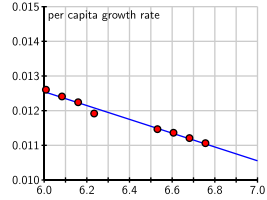
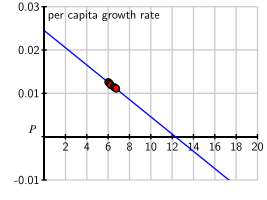
From the data, we see that the per capita growth rate appears to decrease as the population increases. In fact, the points seem to lie very close to a line, which is shown at two different scales in Figure 7.6.4.
The line of best fit to the data shows that the per capita growth rate is an approximately linear function of \(P\text{;}\)\(7\) of the \(8\) points lie on or nearly on the line, with only one point deviating a small amount from the line.
In this figure, \(P\) ranges on the horizontal axis from \(0\) to \(20\text{,}\) and the per capita growth rate on the vertical axis from \(-0.01\) to \(0.03\text{.}\) The line that best fits the data points passes through the points \((0,0.025)\) and \((12.5,0)\text{.}\)
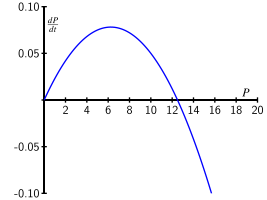
Graphing the dependence of \(dP/dt\) on the population \(P\text{,}\) we see that this differential equation demonstrates a quadratic relationship between \(\frac{dP}{dt}\) and \(P\text{,}\) as shown in Figure 7.6.5.
In this figure, \(P\) ranges on the horizontal axis from \(0\) to \(20\text{,}\) and \(\frac{dP}{dt}\) ranges on the vertical axis from \(-0.1\) to \(0.1\text{.}\) Because \(\frac{dP}{dt}\) is a quadratic function of \(P\text{,}\) the graph is a parabola. The parabola opens down, has zeros at \((0,0)\) and \((12.5,0)\text{,}\) and a vertex at approximately \((6.25,0.75)\text{.}\)
The equation \(\frac{dP}{dt} = P(0.025 - 0.002P)\) is an example of the logistic equation, and is the second model for population growth that we will consider. This model should be more realistic, because the per capita growth rate is a decreasing function of the population.
Indeed, the graph in Figure 7.6.5 shows that there are two equilibrium solutions, \(P=0\text{,}\) which is unstable, and \(P=12.5\text{,}\) which is a stable equilibrium. The graph shows that any solution with \(P(0) \gt 0\) will eventually stabilize around 12.5. Thus, our model predicts the world’s population will eventually stabilize around 12.5 billion.
A prediction for the long-term behavior of the population is a valuable conclusion to draw from our differential equation. We would, however, also like to answer some quantitative questions. For instance, how long will it take to reach a population of 10 billion? To answer this question, we need to find an explicit solution of the equation.
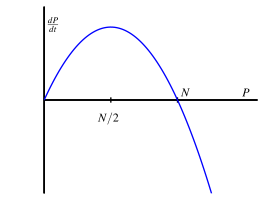
The equilibrium solutions here are \(P=0\) and \(1-\frac PN = 0\text{,}\) which shows that \(P=N\text{.}\) The equilibrium at \(P=N\) is called the carrying capacity of the population for it represents the stable population that can be sustained by the environment.
From the definition of the logarithm, replacing \(e^C\) with \(C\text{,}\) and letting \(C\) absorb the \(\pm\) that arises from the absolute value, we now know that
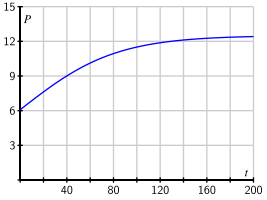
In this figure, \(t\) ranges on the horizontal axis from \(0\) to \(200\text{,}\) and \(P\) ranges on the vertical axis from \(0\) to \(15\text{.}\) The function \(P(t) = \frac{12.5}{1.0546e^{-0.025t} + 1}\) starts in the graph at \((0,6)\) and is an always increasing function that also appears to be always concave down, and that tends to \(P = 12.5\) as \(t\) increases without bound.
The graph shows the population leveling off at 12.5 billion, as we expected, and that the population will be around 10 billion in the year 2050. These results, which we have found using a relatively simple mathematical model, agree fairly well with predictions made using a much more sophisticated model developed by the United Nations.
The logistic equation is good for modeling any situation in which limited growth is possible. For instance, it could model the spread of a flu virus through a population contained on a cruise ship, the rate at which a rumor spreads within a small town, or the behavior of an animal population on an island. Through our work in this section, we have completely solved the logistic equation, regardless of the values of the constants \(N\text{,}\)\(k\text{,}\) and \(P_0\text{.}\) Anytime we encounter a logistic equation, we can apply the formula we found in Equation (7.6.2).
In this figure, \(P\) ranges on the horizontal axis from \(0\) to \(3N/2\text{,}\) where \(N\) is the carrying capacity. There is no scale on the vertical axis for \(\frac{dP}{dt}\text{,}\) but both positive and negative vertical values are shown. Because \(\frac{dP}{dt}\) is a quadratic function of \(P\text{,}\) the graph is a parabola. The parabola opens down, has zeros at \((0,0)\) and \((N,0)\text{,}\) and a vertex at approximately \(P = N/2\text{.}\) Note particularly that \(\frac{dP}{dt}\) is positive for \(0 \lt P \lt N\) and negative for \(P \gt N\text{.}\)
Consider the model for the earth’s population that we recently created: \(\frac{dP}{dt} = P(0.025-0.002P)\text{.}\) At what value of \(P\) is the rate of change greatest? How does that compare to the population in recent years?
If we assume that the rate of growth of a population is proportional to the population, we are led to a model in which the population grows without bound and at a rate that grows without bound.
By assuming that the per capita growth rate decreases as the population grows, we are led to the logistic model of population growth, which predicts that the population will eventually stabilize at the carrying capacity.
The logistic equation may be used to model how a rumor spreads through a group of people. Suppose that \(p(t)\) is the fraction of people that have heard the rumor on day \(t\text{.}\) The equation
Suppose that \(b(t)\) measures the number of bacteria living in a colony in a Petri dish, where \(b\) is measured in thousands and \(t\) is measured in days. One day, you measure that there are 6,000 bacteria and the per capita growth rate is 3. A few days later, you measure that there are 9,000 bacteria and the per capita growth rate is 2.
Assume that the per capita growth rate \(\frac{db/dt}{b}\) is a linear function of \(b\text{.}\) Use the measurements to find this function and write a logistic equation to describe \(\frac{db}{dt}\text{.}\)
Suppose that a long time has passed and that the fish population is stable at the carrying capacity. At this time, humans begin harvesting 20% of the fish every year. Modify the differential equation by adding a term to incorporate the harvesting of fish.