Activity 7.6.3.
Consider the logistic equation
\begin{equation*}
\frac{dP}{dt} = kP(N-P)
\end{equation*}
with the graph of \(\frac{dP}{dt}\) vs. \(P\) shown below.
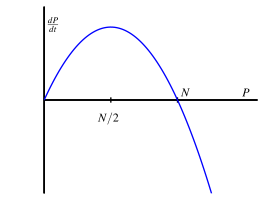
This plot shows \(\frac{dP}{dt}\) as a function of \(P\) for the general form of the logistic differential equation.
In this figure, \(P\) ranges on the horizontal axis from \(0\) to \(3N/2\text{,}\) where \(N\) is the carrying capacity. There is no scale on the vertical axis for \(\frac{dP}{dt}\text{,}\) but both positive and negative vertical values are shown. Because \(\frac{dP}{dt}\) is a quadratic function of \(P\text{,}\) the graph is a parabola. The parabola opens down, has zeros at \((0,0)\) and \((N,0)\text{,}\) and a vertex at approximately \(P = N/2\text{.}\) Note particularly that \(\frac{dP}{dt}\) is positive for \(0 \lt P \lt N\) and negative for \(P \gt N\text{.}\)
(a)
At what value of \(P\) is the rate of change greatest?
(b)
Consider the model for the earth’s population that we recently created: \(\frac{dP}{dt} = P(0.025-0.002P)\text{.}\) At what value of \(P\) is the rate of change greatest? How does that compare to the population in recent years?
(c)
According to the model we developed (recall we found that \(P = \frac{12.5}{1.0546e^{-0.025t} + 1}\)), what will the population be in the year 2100?
(d)
According to the model we developed, when will the population reach 9 billion?
(e)
Now consider the general solution to the general logistic initial value problem that we found, given by
\begin{equation*}
P(t) = \frac{N}{\left(\frac{N-P_0}{P_0}\right)e^{-kNt} + 1}\text{.}
\end{equation*}
Verify algebraically that \(P(0) = P_0\) and that \(\lim_{t\to\infty} P(t) = N\text{.}\)

