Activity 7.3.2.
Consider the initial value problem
\begin{equation*}
\frac{dy}{dt} = 2t-1, \ y(0) = 0
\end{equation*}
(a)
Use Euler’s method with \(\Delta t = 0.2\) to approximate the solution at \(t_i = 0.2, 0.4, 0.6, 0.8\text{,}\) and \(1.0\text{.}\) Record your work in the following table, and sketch the points \((t_i, y_i)\) on the axes provided.
| \(t_i\) | \(y_i\) | \(dy/dt\) | \(\Delta y\) |
| \(0.0000\) | \(0.0000\) | ||
| \(0.2000\) | |||
| \(0.4000\) | |||
| \(0.6000\) | |||
| \(0.8000\) | |||
| \(1.0000\) |
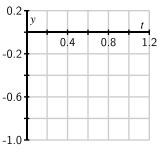
Axes for plotting the \((t_i, y_i)\) points that result from Euler’s method. The \(t\)-values range from \(0\) to \(1.2\text{;}\) the \(y\)-values range from \(-1\) to \(0.2\text{.}\) The grid is \(0.2 \times 0.2\text{.}\)
(b)
Find the exact solution to the original initial value problem and use this function to find the error in your approximation at each one of the points \(t_i\text{.}\)
(c)
How would your computations differ if the initial value was \(y(0) = 1\text{?}\) What does this mean about different solutions to this differential equation?
(d)
Explain why the value \(y_5\) generated by Euler’s method for this initial value problem produces the same value as a left Riemann sum for the definite integral \(\int_0^1 (2t-1)~dt\text{.}\)

