Activity 7.2.3.
Consider the autonomous differential equation
\begin{equation*}
\frac{dy}{dt} = -\frac{1}{2}y(y-4)\text{.}
\end{equation*}
(a)
Make a plot of \(\frac{dy}{dt}\) versus \(y\) on the axes provided. Looking at the graph, for what values of \(y\) does \(y\) increase and for what values of \(y\) does \(y\) decrease?
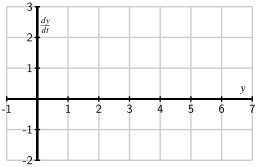
Axes and grid for plotting \(\frac{dy}{dt}\) as a function of \(y\text{.}\) The values of \(y\) range horizontally from \(-1\) to \(7\text{.}\) The values of \(\frac{dy}{dt}\) range vertically from \(-2\) to \(3\text{.}\)
(b)
Identify any equilibrium solutions of the given differential equation.
(c)
Now sketch the slope field for the given differential equation on the axes provided below.
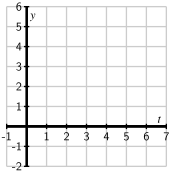
Axes and grid for plotting the slope field. The values of \(t\) range horizontally from \(-1\) to \(7\text{.}\) The values of \(y\) range vertically from \(-2\) to \(6\text{.}\)
(d)
On the slope field in (c), sketch the solutions to the given differential equation that correspond to initial values \(y(0)=-1, 0, 1, \ldots, 5\text{.}\)
(e)
An equilibrium solution \(\overline{y}\) is called stable if nearby solutions converge to \(\overline{y}\text{.}\) This means that if the initial condition varies slightly from \(\overline{y}\text{,}\) then \(\lim_{t\to\infty}y(t) = \overline{y}\text{.}\) Conversely, an equilibrium solution \(\overline{y}\) is called unstable if nearby solutions are pushed away from \(\overline{y}\text{.}\) Using your work above, classify the equilibrium solutions you found in (b) as either stable or unstable.
(f)
Suppose that \(y(t)\) describes the population of a species of living organisms and that the initial value \(y(0)\) is positive. What can you say about the eventual fate of this population?
(g)
Now consider a general autonomous differential equation of the form \(dy/dt = f(y)\text{.}\) Remember that an equilibrium solution \(\overline{y}\) satisfies \(f(\overline{y}) = 0\text{.}\) If we graph \(dy/dt = f(y)\) as a function of \(y\text{,}\) for which of the differential equations represented below is \(\overline{y}\) a stable equilibrium and for which is \(\overline{y}\) unstable? Why?
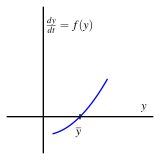
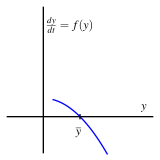
This graph also demonstrates behavior near a point where \(dy/dt = f(y)\) changes sign, but does so in a way that’s opposite the preceding graph.
The graph of \(f(y)\) has a zero at \(y = \overline{y}\text{,}\) and \(f(y) \gt 0\) for \(y \lt \overline{y}\text{,}\) while \(f(y) \lt 0\) for \(y \gt \overline{y}\)

