Activity 7.2.2.
Consider the autonomous differential equation
\begin{equation*}
\frac{dy}{dt} = -\frac{1}{2}(y - 4)\text{.}
\end{equation*}
(a)
Make a plot of \(\frac{dy}{dt}\) versus \(y\) on the axes provided below. Looking at the graph, for what values of \(y\) does \(y\) increase and for what values of \(y\) does \(y\) decrease?
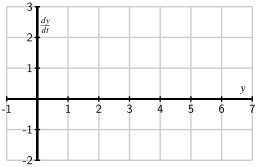
Axes and grid for plotting \(\frac{dy}{dt}\) as a function of \(y\text{.}\) The values of \(y\) range horizontally from \(-1\) to \(7\text{.}\) The values of \(\frac{dy}{dt}\) range vertically from \(-2\) to \(3\text{.}\)
(b)
Next, sketch the slope field for this differential equation on the axes provided below.
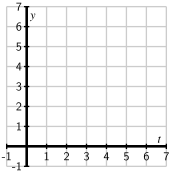
Axes and grid for plotting the slope field. The values of \(t\) range horizontally from \(-1\) to \(7\text{.}\) The values of \(y\) range vertically from \(-1\) to \(7\text{.}\)
(c)
Use your work in (b) to sketch on the same axes solutions that satisfy \(y(0) = 0\text{,}\) \(y(0) = 2\text{,}\) \(y(0) = 4\) and \(y(0) = 6\text{.}\)
(d)
Verify that \(y(t) = 4 + 2e^{-t/2}\) is a solution to the given differential equation with the initial value \(y(0) = 6\text{.}\) Compare its graph to the one you sketched in (c).
(e)
What is special about the solution where \(y(0) = 4\text{?}\)

