Activity 6.4.3.
In each of the following situations, determine the total work required to accomplish the described task. In parts (b) and (c), a key step is to find a formula for a function that describes the curve that forms the side boundary of the tank.
(a)
Consider a vertical cylindrical tank of radius 2 meters and depth 6 meters. Suppose the tank is filled with 4 meters of water of mass density 1000 kg/m\(^3\text{,}\) and the top 1 meter of water is pumped over the top of the tank.
(b)
Consider a hemispherical tank with a radius of 10 feet. Suppose that the tank is full to a depth of 7 feet with water of weight density 62.4 pounds/ft\(^3\text{,}\) and the top 5 feet of water are pumped out of the tank to a tanker truck whose height is 5 feet above the top of the tank.
(c)
Consider a trough with triangular ends, as pictured in the following figure where the tank is 10 feet long, the top is 5 feet wide, and the tank is 4 feet deep. Say that the trough is full to within 1 foot of the top with water of weight density 62.4 pounds/ft\(^3\text{,}\) and a pump is used to empty the tank until the water remaining in the tank is 1 foot deep.
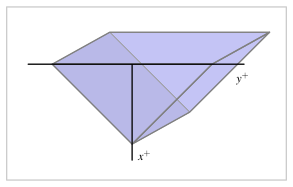
This image is a sketch of the shape of the trough described in part (c) of the activity.
The coordinate axes are oriented \(90^{\circ}\) clockwise from what is typical so that the positive \(y\)-axis points to the right and the positive \(x\)-axis points down. In that orientation, one triangular end of the trough sits so that its top (the opening of the trough) aligns with the \(y\)-axis, and the bottom point of the triangular end sits on the positive \(x\)-axis. The trough itself then extends back from this triangular face so that the image shows the three-dimensional aspect of the tank.

