Activity 5.1.4.
Suppose that \(g\) is given by the graph at left in Figure 5.1.7 and that \(A\) is the corresponding integral function defined by \(A(x) = \int_1^x g(t) \, dt\text{.}\)
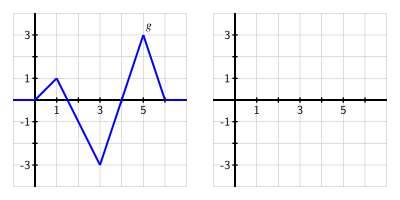
Two sets of adjacent coordinate axes are provided, both showing the independent variable ranging horizontally from \(-1\) to \(7\) and the dependent variable ranging vertically from \(-1\) to \(7\text{.}\) The grid is \(1 \times 1\text{.}\)
On the left axes, the graph of \(y = g(t)\) is provided. This piecewise linear function is \(0\) for \(t \lt 0\) and \(t \gt 6\text{.}\) On the interval \(0 \lt t \lt 1\text{,}\) \(g(t) = t\text{.}\) On the interval \(1 \lt t \lt 3\text{,}\) \(g(t) = 3-2t\text{.}\) On the interval \(3 \lt t \lt 5\text{,}\) \(g(t) = 3(t-4)\text{.}\) And on the interval \(5 \lt t \lt 6\text{,}\) \(g(t) = -3(t-6)\text{.}\)
At right, blank coordinate axes for plotting \(y = A(x) = \int_1^x g(t) \, dt\text{.}\)
(a)
(b)
On what interval(s) do you think \(A\) is concave up? concave down? Why?
(c)
At what point(s) does \(A\) have a relative minimum? a relative maximum?
(d)
Use the given information to determine the exact values of \(A(0)\text{,}\) \(A(1)\text{,}\) \(A(2)\text{,}\) \(A(3)\text{,}\) \(A(4)\text{,}\) \(A(5)\text{,}\) and \(A(6)\text{.}\)
(e)
Based on your responses to all of the preceding questions, sketch a complete and accurate graph of \(y = A(x)\) on the axes provided, being sure to indicate the behavior of \(A\) for \(x \lt 0\) and \(x \gt 6\text{.}\)
(f)
How does the graph of \(B\) compare to \(A\) if \(B\) is instead defined by \(B(x) = \int_0^x g(t) \, dt\text{?}\)

