Activity 5.1.2.
Suppose that the function \(y = f(x)\) is given by the graph shown in Figure 5.1.1, and that the pieces of \(f\) are either portions of lines or portions of circles. In addition, let \(F\) be an antiderivative of \(f\) and say that \(F(0) = -1\text{.}\) Finally, assume that for \(x \le 0\) and \(x \ge 7\text{,}\) \(f(x) = 0\text{.}\)
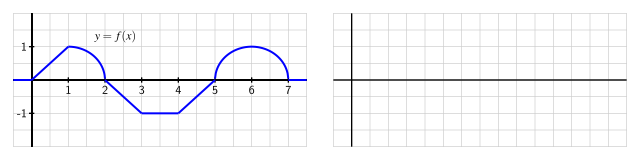
Two sets of adjacent coordinate axes are provided. The left axes have \(x\) ranging horizontally from \(-4\) to \(4\) and \(y\) ranging vertically from \(-2\) to \(2\text{.}\) The grid is \(1 \times 1\text{.}\) The righthand grid and axes are the same size with the same horizontal and vertical scale.
On the left axes, the graph of \(y = f(x)\) is provided (which is the same function considered in Activity 5.1.2). This piecewise linear function is \(0\) for \(x \lt 0\) and \(x \gt 7\text{.}\) On the interval \(0 \lt x \lt 1\text{,}\) \(f(x) = x\text{.}\) On the interval \(1 \lt x \lt 2\text{,}\) \(f(x)\) is a quarter circle that connects points \((1,1)\) and \((2,0)\text{.}\) On the interval \(3 \lt x \lt 4\text{,}\) \(f(x) = -1\text{.}\) On the interval \(4 \lt x \lt 5\text{,}\) \(f(x) = x-5\text{.}\) And on the interval \(5 \lt x \lt 7\text{,}\) \(f(x)\) is the top half of of the circle of radius \(1\) centered at \((6,0)\text{.}\)
At right, blank coordinate axes for plotting the antiderivative of the given function, \(y = F(x)\text{.}\)
(a)
(b)
On what interval(s) is \(F\) concave up? concave down? neither?
(c)
At what point(s) does \(F\) have a relative minimum? a relative maximum?
(d)
Use the given information to determine the exact value of \(F(x)\) for \(x = 1, 2, \ldots, 7\text{.}\) In addition, what are the values of \(F(-1)\) and \(F(8)\text{?}\)
(e)
Based on your responses to all of the preceding questions, sketch a complete and accurate graph of \(y = F(x)\) on the axes provided, being sure to indicate the behavior of \(F\) for \(x \lt 0\) and \(x \gt 7\text{.}\) Clearly indicate the scale on the vertical and horizontal axes of your graph.
(f)
Suppose we change one key piece of information: in particular, say that \(G\) is an antiderivative of \(f\) and \(G(0) = 0\text{.}\) How (if at all) would your answers to the preceding questions change? Sketch a graph of \(G\) on the same axes as the graph of \(F\) you constructed in (e).

